Showing posts with label Scottish research. Show all posts

Tuesday, 24 February 2026

From Angusina to Zepherina: a Scottish Female Naming Custom


Glasgow Electoral Roll, Ancestry.co.uk

I’ve often said that Scots parents never met a male name they couldn’t tack "-ina" onto the end of, and the names I've encountered in the records over the years have only served to confirm this.

I first encountered this phenomenon – if it can be called that – in my Glasgow childhood. When I was growing up in a sandstone tenement building comprised of eight flats, we were on fairly close* terms with some of the neighbours. One of the ground floor apartments was the home of three elderly sisters from the Isle of Mull, the Misses MacInnes (see the above voters' roll). The lady who I knew as “Ina”, I later learned from my mother, was actually “Archina”. Thus my interest was sparked in this very Scottish naming custom.

What could account for this quirk? Well, a tradition in many Scottish families held that the first male child should be named after his paternal grandfather; the second son after the maternal grandfather; the third son was given his father’s name. The first daughter was given the name of her mother’s mother, the second that of her father’s mother, and the third daughter was named after her own mother. Thereafter, particularly in large families, it could be a free-for-all as aunts and uncles fought for primacy.

These were by no means hard and fast customs, though. For instance, if both parents’ mothers were called Agnes, they wouldn’t usually have two daughters called that – not usually. When you’re tracing British families (and no doubt those of other nations), you may often see a couple having more than one child given the same name – e.g. two Margarets born to Mr and Mrs Johnson, four years apart. This is normally explained by the discovery that the first Margaret died in infancy before the second Margaret was named. Repeated naming would be more likely if Margaret was a name that appeared in either parent’s family, in an effort to preserve the tradition.

I came across a very sad case in Ayrshire, although it is by no means unique. Over a 23-year period, the parents tried four times to name a son Joseph after his father. Unfortunately, each time the child died in infancy.  This was during the mid-nineteenth century when infant mortality in this coal-mining area was high, due to poor living conditions and non-existent sanitation.

However, there is something I’ve noticed that’s particularly true of families from the Scottish Highlands and Western Isles: it wasn’t out of the question to give two (or more) surviving children the same name. Quite often, I have seen similar names given to siblings – in one case, a daughter called Katie Mary and a daughter called Kate Ann were born twelve years apart. Katie Mary lived well into her 90s, while her younger sister Kate Ann sadly died aged eleven. Both their grandmothers were named Catherine so I suspect this may have influenced their parents’ name choices.

In my more immediate family, my grandfather Donald went to extremes with three of his five sons: John was the eldest after Donald’s father, then the second son was called Angus John, and finally my father, the youngest of the tribe, was Donald John, after his father and his grandfather. There is some trace of the naming pattern in that family, but it’s all over the place. Families clearly adapted it to suit their own preferences and family structure.

But what does this naming pattern have to do with the adoption of feminine versions of male names? Well, if several girls were born into a family before any boys, the parents might have felt obligated to hedge their bets by calling some daughters after grandfathers, rather than take the risk of never having any sons with whom to honour the menfolk.

Another interesting aspect of -ina names is the forms to which these were shortened in later life – that is, the form which appears on other vital and census records. My personal favourite of these feminine names is Campbellina, perhaps because she was the hardest to find anywhere else using the name which I first found her recorded under (see below), in the 1841 census – Camilina – after, I later found, the surname of her maternal grandmother, Mary Campbell. Perhaps there had been other Marys born into the family and her mother wanted to avoid confusion? Or maybe she wanted her daughter to stand out. Whatever the reason, searching for her in other records meant liberal use of the wildcard search plus some imagination. It wasn’t until I looked for her marriage record that I realised how her name was originally intended to be spelled. Until that point I had been labouring under the mistaken idea that her parents had plucked the name “Camilla” out of the ether.


1841 Census, Greenock, FamilySearch.org


In my ancestral database, there are almost 200 women with a given name ending in -ina, out of over 4,700 females. Christina is the most common with 108, more than half being born in Scotland (67), which is not surprising as most of my ancestry is Scottish. It’s not an uncommon name throughout the English-speaking world, either. Coming far behind in my tree, close together are Alexandrina and Williamina, plus their multiple variants (Alexina, Wilma, etc.), with 20 and 16 respectively, neither of which are particularly unusual in previous centuries.

Other less obvious alternative forms I have found are: Lexy=Alexandrina; Kennick (-ick being derived from a Gaelic diminutive) =Kennethina; Dolly=Dolina; and Ruby=Robina. Of course, many of these women would have been known simply as “Ina” (or "Ena"), like my former neighbour, which can be problematic for their descendants, who have to try and work out which “-ina” they should be looking for!

To prove my earlier point about any male name being fair game for feminisation, I give you, courtesy of ScotlandsPeople as well as my own tree: Alfredina, Angusina, Archibaldina, Charlesina, Donaldina, Gavina, Hughina, Jacobina (possibly a Jacobite in the family?!), Jamesina, Malcolmina, Murdina (for Murdoch), Peterina; and, of uncertain motivation - and definitely not Scottish - we have Zepherina, who was born in Québec.

I'm sure there are a few outliers that I've forgotten, or haven't yet come across. If you have any unusual omissions you care to share, do pop them in the comments. As I said to a friend recently, I'm still running into the occasional example that makes me think, "Oh, come ON!"

If you'd like to learn more about Scottish family naming customs, there's some good guidance on the ScotlandsPeople website.


* no Glasgwegian pun intended

Sunday, 14 December 2025

Genealogy presents...


Just in time for Christmas, here are a few family history gifts that cost you (and me) absolutely nothing.

🎄 Last month FamilySearch released over 18 million new records on their website. We're used to such huge numbers in many fields nowadays, but think about that for a minute: eighteen million. That represents at least eighteen million individuals, depending on how many people are named in each record. The records cover countries in Africa, Asia, Polynesia, Europe, and the Americas. And Essex. 

🎄 Bag a free digital guide to researching military ancestors. Written by military historian Graham Bandy, it's on offer if you sign up for regular e-mails from Family Tree magazine (although if you don't want to keep receiving the e-mails, you can un-sign up for them after receiving the link to this 52-page guide). This offer ends on 31st January. 

🎄 Beginning (and ending) on 31st January UK time - 1st February antipodean time - is Scottish Indexes' 31st free conference. As always, all the presentations will be shown twice, at different times to suit time zones around the world. Register to watch via Zoom, or join via the Scottish Indexes Facebook Group; you can find out more on the website. Nearer the date of the conference, the schedule will be published there too. Some inside information: there *may* be a talk about Scottish church records.

Wishing you, wherever you are and wherever your roots are from, a happy and peaceful Christmas, and the best New Year in 2026!

Thursday, 7 August 2025

Some Recent Discoveries


Image by SimoneVomFeld on Pixabay

You may already be familiar with some or all of these websites, but I’ve only recently come across them! I found them all really useful and enlightening, and have bookmarked them for future use.


A Dictionary of Occupational Terms Based on the Classification of Occupations used in the Census of Population, 1921

Some twentieth-century occupations may have changed their name, be very niche, or no longer exist. For instance, what’s a kapok worker? What’s kapok, for that matter?! What does an uncallower do? Which industry would a brilliandeer work in? Find out in the Dictionary of Occupational Terms that was produced to accompany the 1921 UK census.


Scottish Mining Website

A friend recently pointed me in the direction of this tremendous resource. It lists mines operational in Scotland for certain years in the 19th and 20th centuries, and has a mining accident section from before 1840 up until 1939.

Various resources such as government reports and newspaper articles are included throughout the site. One fascinating page lists miners’ wages and the cost of living from the 17th century until after World War Two. If your Scots ancestors were mineworkers, you’re sure to learn something new about the lives they led, as well as their work.


2025 Rhind Lectures on Scotland’s Place-Names 

I recently watched these lectures live. They’re sponsored by the Society of Antiquaries of Scotland and were free to view over the weekend when they took place. Now they’re available to watch on YouTube. This year’s theme was “Scotland’s Place-Names” and I learned so much about the survival of various languages in Scotland via the names that were given to places by their inhabitants and others. 

Several topics were addressed, including archaeology and religion. The lectures were delivered by Dr Simon Taylor, an academic in this field with over 30 years’ worth of expertise, and it was a pleasure to listen to someone so knowledgeable about his subject.


Presbyterian Historical Society of Ireland

In a previous blog post, I extolled the virtues of joining a family history society – but other historical societies and heritage groups can also be of help to genealogical research. One such is the Presbyterian Historical Society of Ireland. Whether your ancestor was a congregant or a minister of a Presbyterian church on the island, the society has records and advice for your research.

You can learn more about the organisation and its purposes by viewing the slide collection which explains the origins of different forms of Irish Presybterianism.

The society also has an active events programme and some of their previous lectures can be found on YouTube.


Saturday, 25 January 2025

Finding Your Scots Ancestors - Free Resources


Dundee Courier, 1921

To celebrate the birthday on January 25th of Scotland’s national bard, Robert Burns, I’ve put together a selection of free websites that may help you to grow your Scottish family tree a bit. This is an updated version of a previous blog post from 2021.

Glasgow Valuation Rolls,1913-1914  Learn about and search these lists of Glasgow owners and occupiers, with the value of their properties, to locate your early 20th-century relatives living in the city.

ScotlandsPlaces  In 18th-century Scotland, if something moved (or even if it didn’t), it got taxed. Horses, carts, dogs, clocks, watches – oh, and people, too. Household and farm servants may be listed under their employers’ names. You can also trace the history of a place through time, even a relatively small place, using Ordnance Survey records as well as property and business tax ledgers. And there are plenty of maps, plans, and photos, too.

Statistical Accounts of Scotland 1791-1845  Background information for the entire country, parish by parish, in the 18th and 19th centuries.  These books were compiled from contemporary accounts written by locals about their own area, with descriptions of the parish, its history, its natural features and industries.  Excellent for learning about the times and places your ancestors lived in.

Scots Abroad  Whether your relatives went abroad to work, live, or visit, they may appear in these databases hosted by the National Library of Scotland.  These include correspondence from emigrants and guides for those who were planning to emigrate to different parts of the world.  Get a flavour of what life would have been like for people taking the big step away from Scotland.

Scottish Emigration Database  Search by the name of a person or the ship they sailed on. Thousands of entries from 1890 to 1960 list the address from which they were emigrating and their destination overseas.

Kirk Session Records  Find out what your ancestors got up to when they were hauled before the minister and elders. There are links on this page to resources for understanding the context and social history behind these records, as well as the sometimes-difficult handwriting.

Dictionary of the Scots Language  Also handy for reading older records as well as Burns' poetry is this online dictionary of Scots. It is a separate language, ye ken.

Thursday, 19 December 2024

Henry Wyatt & the Good Templars

In Memoriam. The late Bro. Henry Wyatt. A photograph of an elderly Victorian man with mutton chop whiskers, dressed in a black suit and white shirt, with small black tie
Obituary, The Good Templar

A few weeks ago, in the Scottish Indexes online conference Q&A session, a viewer asked about sourcing records for the temperance organisation, the Good Templars.

I was surprised, but happy to answer the question, because some years ago, I researched a family whose father was a member of this Victorian order. Plenty of information about the family, the Wyatts, had been forthcoming from the usual BMD and census records, and more was to be discovered in Post Office directories, electoral rolls, journals, and newspapers - all from the starting point of the newspaper announcement where I came across the Good Templars for the first time:


Glasgow Herald, 27 November 1899


Not having realised that Henry was part of something bigger, I researched the Good Templar organisation at Glasgow's Mitchell Library and found that they held a run of Good Templar journals. Here I was astonished to see the picture of Henry (at the head of this article) staring back at me from his obituary.

Born in the parish of Holborn, London around 1824, according to census returns – although the church records of the parish haven’t yet yielded up any proof of this – Henry Wyatt arrived in Glasgow in the late 1840s. He and his wife, Sarah Ann Reynolds, had seven children, all born in Glasgow between 1847 and 1858: Joseph, Benjamin, Mary Jane, Elizabeth, Emily, Sarah Ann, and Margaret. The family seemed to be attached to the Episcopal Church in the heart of the city, St Andrews by the Green,1 where four of their first five babies were christened. The one exception, Elizabeth, was taken to Christ Church in Bridgeton, an East end Episcopal church, for her baptism, while the next child, Emily, was brought to St Andrews to be christened. Whether this back-and-forth was due to the usual church being temporarily out of commission, a relative’s choice, or a preference for a specific clergyman, is still not clear.

A modest-looking 19th century church built of pale stone, with no spire or steeple

Former church of St. Andrew's-by-the-Green, kim traynor, CC BY-SA 2.0


In 1855, Henry’s father Benjamin travelled to Glasgow from England. Widowed when Henry was a boy, Benjamin had remarried in 1831 in Liverpool, and it was there that his second wife had died in the summer of 1854. It’s unclear whether he planned to remain in Glasgow with Henry, because a month after his arrival, he died after suffering from gastritis for eight weeks. This would have been a devastating blow to his family as he was only 54 years old; however, the date of his demise was a big genealogy plus, as this was the year in which civil registration had been introduced in Scotland. For just 1855, extra details were included in birth, marriage, and death records, meaning that a lot of information was gleaned about the Wyatt family.

Henry registered his father’s death, and the certificate recorded all of the following: Benjamin had been born around 1802 in London and had been married twice. His first wife was Henry’s mother, Mary Soliman, and together they had four children: Caroline, born about 1820, Susanna, who died in 1822 aged 1, Emma, born 1824, and Henry. Benjamin’s second wife was Frances Higham (their marriage produced no children according to the certificate) and his parents were named as Edward Wyatt, a lamplighter, and Susan, whose maiden surname was unknown. This proved a great foundation on which to build the structure of the family, chasing up and trying to confirm (or otherwise!) all these details.

It later came to light that Caroline also moved to Glasgow, was married, and lived to the splendid old age of 96.

Henry continued to earn a living by various means, as indicated in the census. His occupation was listed as, from 1851, a clothes broker and a general dealer, and by 1871 he had become a hotel keeper. This may have been precipitated by his sequestration that March, as recorded in the Edinburgh Gazette: “The Estates of Wyatt & Company, Furnishing Warehousemen in Glasgow, and Henry Wyatt, Furnishing Warehouseman in Glasgow, the sole Individual Partner thereof, as such Partner, and as an Individual, were sequestrated on the 3d day of March 1871, by the Sheriff of Lanarkshire."2 How he managed to get back on his feet in such impressive style, I was never able to discover!

Among all this wheeling and dealing, in 1867 Sarah Ann died at the relatively (even for those days) early age of 41. The cause of death on her burial record is noted as “Debility”, an unsatisfyingly vague description. Four months later, Henry married Mary Mitchell, seventeen years his junior and the daughter of Irish immigrants. Records don’t show them having any further children, but Mary would have had her hands full anyway, with all five girls still living at home, ranging in ages from 9 to 16.

In the 1871 census Henry’s home address was given as 63 Candleriggs, and this was also the location of one of his hotels. As can be seen in the advert below, he was by now involved with the Good Templars and operated his establishment as a temperance hotel.3 This was an idea begun by the abstention campaigner Joseph Livesey in the 1830s. It was intended to provide a "dry" alternative to the ubiquitous availability of alcohol in lodging-houses and inns, in an effort to check the spread of drink-related social issues in Britain.4


Wyatt's Commercial & Good Templars' Hotel, 63 Candleriggs Street, Glasgow. Plain Breakfast 9d; with Eggs, 1s; with Ham and Eggs, 1s 3d; with Steak or Chop, 1s 6d. Beds, boots, and attendance, 1s 6d. Commercial room, and ladies’ private sitting room. First-class accommodation.  Post Office Directory advert, 1875.
Post Office Directory advert, 1875

The temperance movement used a variety of methods to appeal to people and convince them of the evils of “the demon drink”, and Henry seemed to be deeply committed to this cause. He had become a member of its “Scotland’s First” lodge soon after it was set up in Glasgow, in August of 1869, at a meeting of the United Working Men’s Total Abstinence Society.5 Its fraternal nature was similar to that of the Freemasons and other groups who claimed good works as their main focus, although the Templars also admitted female members.

Henry’s daughter Sarah Ann was recorded as working as an assistant manager in the Candleriggs location. The Wyatt temperance hotels expanded to include two more in Glasgow, in nearby Brunswick Street and in Dundas Street, and eventually one in the Ayrshire coast town of Prestwick.

His obituary outlined the work Henry carried out in support of the temperance movement: “For many years he was a fearless champion of the cause. He conducted Temperance meetings on [Glasgow] Green with much acceptance. His genial, happy manner carried conviction, and led many to sign the pledge.”6  This referred to the abstinence pledge that temperance workers encouraged everyone to take, swearing off alcohol for life.


Uxbridge Temperance Hall. The Universal Organization of Good Templars Pledge. “You, in the presence of Almighty God, and of these witnesses, solemnly and unreservedly promise that you will never make, buy, sell, use, furnish, or cause to be furnished to others, as beverage, any Spirituous Liquors, Wine or Cider and that in all honorable ways you will discountenance their use in the community.” 19th Century Canadian Good Templar Pledge.
19th century Canadian Good Templar Pledge


Things appeared to be going well for Henry in the 1880s, but this wasn't to last. Further bankruptcy proceedings were initiated in 1887, with Henry being described as a "hotel proprietor dealer in furniture". He clearly enjoyed having more than one string to his bow, but perhaps this caused him to overextend financially. A few years later he was still operating the hotels in Brunswick Street and Dundas Street, as well as a restaurant next door to the latter.7

By the end of the decade he had relocated himself, wife, and business to Prestwick. He transferred his Good Templar membership to the local “St Nicholas” lodge and continued his association with the temperance cause. Unfortunately financial ruin continued to dog his footsteps, and an article in the Glasgow Herald in November of 1897 reported Henry’s detailed account of his hotel businesses and family assets. He was 73 by this time and not in good health, being unable to read handwriting (as opposed to printed matter) and therefore his bookkeeper’s ledgers.8

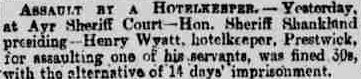
The strain of this had possibly led to this blot on his copybook, just a few months previously9:


Newspaper article: Assault by a hotelkeeper. – Yesterday, at Ayr Sheriff Court – Hon. Sheriff Shankland presiding – Henry Wyatt, hotelkeeper, Prestwick, for assaulting one of his servants, was fined 30s, with the alternative of 14 days’ imprisonment.

I would hope that he was able to take the fine option...

On the 24 November 1899, Henry died at his home, South Lodge in Prestwick, of dropsy – a term used to describe the symptoms of what was often heart failure.10 His obituary referred to his “lengthened illness”.

Henry was buried in Glasgow, in the Southern Necropolis, and his funeral was conducted by his fellow Templars.11  It was this obituary, published in the Good Templar journal, that allowed me to learn about his service in the temperance movement, so I suggested these journals to the researcher who was looking for records. I neglected to tell her that the Templars' Scottish records are held at Glasgow University Archives - perhaps I should take my own advice and visit them to learn even more about Henry!


1 St Andrews by the Green Episcopal Church, Glasgow, Ref. TD243, Glasgow City Archive.

2 Edinburgh Gazette, 7 March 1871, https://www.thegazette.co.uk/Edinburgh/issue/8143/page/176.

3 Post-office annual Glasgow Directory, 1875-1876, https://digital.nls.uk/directories/browse/archive/84188037.

4 Helensburgh Heritage Trust, Temperance hotels were popular, https://helensburgh-heritage.co.uk/index.php.

5 Records of the International Order of Good Templars: Grand Lodge of Scotland, held at University of Glasgow Archive Services, https://archiveshub.jisc.ac.uk/search/archives/012fd6d2-c9e9-3cca-9807-aa919bf43c22

6 The Good Templar journal, c. 1900, Mitchell Library, Glasgow.

7 Post-office annual Glasgow Directory, 1897-1898, https://digital.nls.uk/directories/browse/archive/85331301.

8 Glasgow Herald, 27 November 1897.

9 Glasgow Herald, 12 August 1897.

10 “Dropsy,” University of Leeds Library Special Collections, https://library.leeds.ac.uk/special-collections/collection/2156.

11 The Good Templar journal, op. cit.


Saturday, 30 November 2024

Happy St Andrew's Day

Illustration by Martin Aitchison from
A First Book of Saints (1963) by
Hilda I. Rostron


Scotland's patron saint, St Andrew, is celebrated on the 30th November. I remember, as a kid, reading a Ladybird book about the patron saints of the different nations of the UK and Ireland, and managed to find a copy of it more recently. The illustration above is taken from the chapter about St Andrew and shows the monks who are supposed to have brought his remains to Scotland.

Just to do my bit to mark this special day, here are some tips for boosting your Scottish family tree.

National Records of Scotland are noting a historical landmark concerning one of Scotland's favourite pastimes. Tickets for the in-person event are sold out, but the event is being live-streamed on the 4th December at 1.30pm (UK time). Book your virtual (and free) ticket here to hear sports historian Andy Mitchell talk about 200 years of football in Edinburgh.

The Scottish Association of Family History Societies has member societies from around the world, not just Scotland. Check out the list on their website and consider joining one (or more!) society that matches your research interests. Many are now providing remote access to their meetings which previously were only available in person.

The National Library of Scotland has some excellent resources for genealogists, including Post Office Directories, Maps, and the Scotsman newspaper digital archive. It also has great guidance on lots of different aspects of Scottish family history. And if you live in Scotland, you can register for free access to many of their other digital collections.

SCAN - The Scottish Archive Network will be archiving its website early in 2025. It's been one of my go-to places to understand more about Scottish records. Learn more about the change on the current site

Have a great St Andrew's Day!


Monday, 18 November 2024

Scottish Indexes November 2024 Conference


Coming this Saturday, the 23rd November, is the latest online Scottish Indexes Conference, free to all.  The programme features the following:

'On the Boll: agricultural and landholding terminology in Scottish records' by Robert Urquhart

'Housing the Miners' by Kay Williams

'Town and Gown – St Andrews University Archive' by Sarah Rodriguez

‘Historic Scotland in the archives: Using Historic Environment Scotland Archives to explore historic sites around Scotland’ by Joseph Waterfield

'Using the internet & PRONI for Northern Irish research' by Chris Paton

'Beyond ScotlandsPeople: Breaking Down Brick Walls in Scottish Research' by Alison Spring

Scottish Genealogy Q&A hosted by Graham and Emma Maxwell

There will be Q&A sessions after the presentations when you will have the opportunity to submit your questions for the speakers.

Download the international time zone-friendly conference schedule at

https://www.scottishindexes.com/conference.aspx 

Each presentation will be shown twice at difference points throughout the day, and you can dip in and out as you wish, either on Zoom or by joining the Scottish Indexes Facebook Group.  

Visit the Scottish Indexes website to register for the Zoom broadcast and to read more about the conference.

Oh, and do tune in for my presentation for some help with breaking down your family history brick wall!


Tuesday, 27 August 2024

Recent Delvings

Image by Angelo Giordano from Pixabay

In the last short while, I've come across some great online resources to help me with my genealogical research. They may be well-known to you already, but I'm just discovering them! If they're new to you, too, I hope you find them as useful and interesting as I do.


Maritime History Archive

The Maritime History Archive, created by Memorial University, holds approximately 75 percent of the surviving crew lists (also called crew agreements) and official log books of British registered vessels for the periods 1857-1942 (predominantly 1863-1938) and 1951-1976.  I found out about this great resource when a kind friend used it to identify the means by which a relative of mine arrived in the United States. Thanks, Ardis!


Gaelic Place-Names of Scotland 

This provides the origins of Scottish locations whose names originate in the Gaelic language. Many other place names derive from Brythonic Celtic, Scots, Norse or English, though. I can highly recommend the excellent book “Glasgow’s Gaelic Place-names” for explanations of the different sources for some of the city's place names. 

Birlinn also publish “The Celtic Place-names of Scotland”, in e-book format. This is an older title that covers British, Pictish, and Gaelic place names, and some chapters from it are available on the website of the Scottish Place-Name Society under “Resources”. This site covers the subject in great detail, and it's fascinating to learn about the name origins of the places where our ancestors lived.


Registry of Deeds Index Project Ireland

The Registry is described as “a repository of records of wills, land transactions in Ireland and other deeds from 1709”. This website hosts an index and a guide to using the free-to-view FamilySearch digital collection of these records.


Ulster Historical Foundation

This organisation hosts many records, including a freely searchable index of migrant Ulster Scots, and smaller, more area-specific databases. This is a society well worth joining for the member-only records it provides!


Hebrides People (formerly Cò Leis Thu?) 

A long-time favourite website of mine has had a makeover. For genealogies of the Western Isles, you can’t get better than this site which draws on oral histories as well as land, church, and state records. Its Croft History series of books is excellent; if your ancestors hailed from any of the Outer Hebrides, these are invaluable for finding detailed information about those who lived and worked there, and those who left for other parts of the world.


Maintenance Alert

Next week, ScotlandsPeople will be offline as the website is "refreshed". The scheduled work will take place from 0001 on Sunday 1st September until 1200 on Tuesday 3rd September (BST). Hopefully it will mean improvements to the usability of the site!