Wednesday, 20 November 2019

Listen Up!


Dictionary definition of podcast: a digital audio file made available on the Internet for downloading to a computer or mobile device, typically available as a series, new instalments of which can be received by subscribers automatically

This week I thought I’d return to the topic of how to go about developing new skills and educating ourselves in the ways of the genealogist.  One very simple and frugal way is to listen to podcasts. 

Family history podcasts seem to abound, but I’ve chosen just a few to give a taste of what's available.  From both the UK and the US, their presenters discuss areas of special interest and share stories of success in growing family trees.  These can range from cold case murders to house histories, parish records to software reviews.  Most podcasts provide a brief summary of the content of each episode, allowing you to pick one on a subject that interests you or that will help you tackle a brick wall.

Some of the presenters are sponsored by commercial organisations, some are independent enthusiasts, and some are professional historians.  All share a common passion for exploring the past and sharing their knowledge.

Woman on bus with headphonesBeing easily downloadable, podcasts are great for a long journey – unless, of course, you’re the driver and the spoken word tends to send you to sleep!  
However you plan on listening to them, do try one or two of these out:


Wednesday, 13 November 2019

Gifts of Genealogy


It’s approaching the time of year when “What can I buy X for Christmas?” becomes the most pressing question.  If your nearest and dearest happen to be into family history, I have some gift ideas that don’t (a) include a DNA kit or (b) cost a fortune.  Handmade, personalised presents are the most thoughtful of all, I reckon.  And what could be more personal than the gift of heritage?  Here are my suggestions:

 A framed family tree.  There are many ways to present this; if you have a steady hand and good penmanship (or a decent Italic pen), your costs can be limited to finding a suitable frame and paper – both available at budget stores.  Or your local charity shop might have some pictures for sale whose frames can be re-used.


Another option is to print a chart.  Family history computer programs can do this, with varying degrees of eye-catchingness.  FamilySearch allows users to freely print out their tree in a range of attractive formats.
 
If you have enough photographs of the people featured on the tree, these can be mounted on a chart, with or without name labels.
 
Photographs.  Compile an album for an older relative to prompt memories, and perhaps some heart-warming recollections too.  Frame any number of photographs to make a conversation piece for the hall, stairway, or living room – either in a collage frame or individually.
 
This Is Your Life.  The photo album idea could be taken a stage further to include mementos such as programmes, letters, postcards, certificates and so on, forming a record of the recipient’s life.  An appropriate presentation ceremony would add to the occasion!

Frame an heirloom.  This isn’t as unlikely as it sounds.  Medals are an obvious choice, and can be combined with photographs.  These could be military or sports awards; one of my great-uncles took part in a police tug-of-war team, and I still have the medal to show for it.  Other heirlooms might include a wedding favour, a piece of fabric with a special meaning, or even an item of jewellery.
 
A Gift For My Grandchild.  Although these types of books are available commercially, a homemade version would be something to cherish.  Starting with the grandparent, it can tell the story of how the family has grown to include the grandchild.  Make it even more personal with lists of favourite music, books, food etc., and include blank pages for the child to add their own artwork and memories.  You can find plenty of inspiration online for creating a unique family keepsake.
 
Keeping A Diary.  Generic notebooks can be transformed into the gift of a personal journal, diary or travel log – or you can buy ready-made ones quite cheaply.  Personalise the book by adding a photograph or the recipient’s name or initials to the cover.  To get them started with their writing, include a journal jar in the gift.  Any decent-sized jam jar can be transformed with ribbon or other embellishments.  Write “prompts” on small slips of coloured paper to put in the jar.  These can be questions such as “What did you most enjoy about today?” or ideas like “Write a description of your garden”. 
 
This idea might also be applied to someone writing their own life history.  Again, there is no shortage of suggestions on the internet; just search for “journal jar”.
 
 Give Them Their Story.  This may require a bit of pre-planning, and co-operation from your relative, but it can be very worthwhile for the giver too.  Over a number of occasions, chat to the intended recipient about their life, using photographs or other memory-joggers, and (with their permission, naturally) record their recollections.  This could be on paper, if your shorthand’s up to it, on tape or digital voice recorder, or on video.  Follow up by transcribing the conversation and then typing it up and compiling a book(let).  Add photos as above, bind in a folder, and gift-wrap.

As a prelude to Christmas, I’d like to finish with this video by Martin Lewis
which, if you’ve not seen before, I would urge you to watch.  Being frugal isn’t just about saving money, it’s about peace of mind, and what says more about Christmas than peace?  


Wednesday, 6 November 2019

The Best Source of Local Knowledge


Quiet cobbled village street, wooden houses
A recent chat with a fellow family historian prompted me to think about how helpful it can be to draw on the resources of family history societies, heritage groups and local history organisations. 

Usually these groups are run by volunteers and focus on a subject of common interest, like the area where ancestors lived or originated from.  Other societies are based on religious affiliation e.g. the Quaker FHS or ethnic background e.g. the Romany and Traveller FHS.  Some groups cover a broader subject area, such as the Family and Community Historical Research Society (FACHRS)

Paying to join a society is customary and although these charges vary, they’re usually fairly affordable.  However, society meetings are often open to non-members for an entrance fee, and are one of the most accessible aspects of family history societies’ work.  Attending a meeting can be a good way of gauging whether membership will benefit you.  Check out your local family history society’s website for their calendar of upcoming events in your area, as well as membership rates and details of ongoing heritage projects.

Another feature of many societies is their local research premises, sometimes hosted in a library or archive.  Here you can access indexes to census returns, gravestone inscriptions, parish registers, newspapers and other resources that society members have compiled or collected.  Some may have microfilm copies of original records to browse through.

One of the aims of family history societies is to connect members who have common ancestry.  They do this by compiling a register of members’ interests and publishing society magazines or newsletters.  Access to these is included in membership fees.

So how do you identify a society that covers your area of interest – for instance, the county where your forebears hailed from?  A good starting point is the website of a national umbrella group.  In the UK, these include the Family History Federation and the Scottish Association of Family History Societies.  Links to other historical societies and genealogical groups from around the world are found at genealogy directory Cyndi's List.

You can also try searching on social media for an organisation related to your ancestors; many FH societies have Facebook or Twitter accounts, offering another way to get in touch with them.

One very active group is the Families in British India Society Their website hosts resources and ideas for tracing those in your tree who, for example, served in the British Army or the East India Company in the subcontinent.

The Ulster Historical Foundation boasts a rather impressive website which includes a bookshop for those hard-to-find genealogical publications, and some free finding tools such as a list of Ulster graveyards.

One example of a society which has a broad reach is the Northumberland and Durham FHS, which has branches not only in local towns but also in London – this is true of other organisations, like the Aberdeen and North-East Scotland FHS, which also has groups in Glasgow and Manchester.

When you’re researching an area for the first time, an excellent way to learn more is to contact the relevant family history society for advice.  You’ll find the members are more than happy to give you pointers on where to look for the information you need, especially when the organisation has close links to local archives.  Some FH societies offer remote research for a charge, if you aren’t able to visit the area in person.

My tip this week is to look at the branch, twig, or leaf of your family tree that’s causing you the most headaches, and then find a society in that county or town to check out online.  Contact them with your question and ask them to suggest a solution.  If they are helpful, consider making a donation if you aren’t going to become a member.  Societies like these depend on voluntary donations from their members and others who have used their resources.  And if you do join a family history society, get involved and give back, especially to those who follow in your footsteps.

Wednesday, 30 October 2019

RootsTech London - Free, or Not


Looking down on FindMyPast and Ancestry stands at RootsTech
Of the three major family history shows I’ve been to this past year (the other two being Family Tree Live and The Genealogy Show), by far the largest and most energising has been RootsTech London which was held over three days last week.  Some criticism was levelled at the choice of a London venue as it disadvantaged people in the rest of the UK, but it was clear from the organisers’ remarks during the event that they saw London as central to sharing family history knowledge and resources with the rest of the world. 

RootsTech began almost ten years ago in the United States, and this was the first time it had ventured elsewhere.  Much advance publicity, and special discounted ticket rates from various companies (sometimes confusingly competing with each other!) were available to help people decide if they wanted to attend.  My main gripe was that the schedule of workshops wasn’t available until the price of travel and accommodation was almost at the astronomical level.  However, I heard from a few genealogists on Twitter who managed to bag good value hotel rooms relatively near to the date, so it wasn’t all bad news.

I had already decided to attend all three days of the conference and had gone for the “book before you can’t afford it” strategy for my travel and hotel room.  In the end it worked out pretty well as it meant I had over one hundred classes to choose from, all of which were included in the ticket price.  The free RootsTech mobile app was available to download well in advance of the event, a really useful tool in planning my schedule and connecting with other genealogists (and even distant relatives) who were attending.

Visitors and reps at 23andMe stand
Genealogy DNA companies were very much in evidence
As the workshops were all offered on a “first come, first served” basis, it occasionally meant people being turned away when a class was full, but there were so many other options that it wasn’t the end of the world.  As well as up to ten classes running simultaneously in each timeslot, there were presentations in the main exhibition hall.  These were run by some of the big boys in the family history market like FindMyPast, Ancestry, FamilySearch, and Family Tree Maker, promoting their wares via informative talks and Q&A sessions.
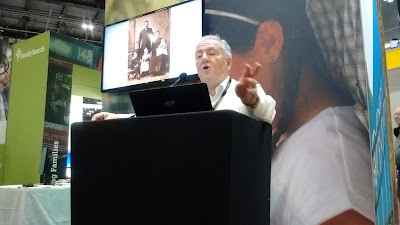
Speaker on the FamilySearch stand
The FamilySearch stand had a variety of informative free talks on offer
Everything in the exhibition hall - presentations, interactive displays, stalls in abundance, advice from friendly experts and volunteers - was free, as was entry to the main exhibition hall itself.  This price-less aspect of the conference wasn’t promoted nearly as early or widely as it should have been, and of course was of most benefit to those living in and around the London area.  There was also a nifty free RootsTech backpack, handed out to each attendee, plus free bits and bobs to be collected from the stands around the hall.

Also included in the price of the ticket was entry to the daily keynote sessions in the large auditorium.  Compered by historian Nick Barratt, these featured a different well-known personality each day, who shared with us their own history and how they had come to appreciate it, through very different routes.  TV presenter and historian Dan Snow, Paralympian Kadeena Cox, and singer Donny Osmond all spoke about their family backgrounds and how this had influenced the person they had become.  I was most impressed by Dan Snow, who had a very engaging and natural style and told the eye-opening story of his great-grandfather who had been a general during the Battle of the Somme.  You can watch his presentation here.

This is another moneysaving angle to RootsTech of which I heartily approve.  Each day three sessions, including the keynote talks, could be viewed live online by anyone.  And since the conference, more presentations have been posted and made available without charge.  RootsTech sell a “Virtual Pass” which will allow several months' worth of access to 20 classes which were filmed and will be posted online within a few weeks.  HOWEVER, frugal family history pals, the Virtual Pass section of the website also states that after the nine months’ access expires at the end of July 2020, all these videos will be made freely available at no cost.  These will hopefully allow you to get as much out of the classes as those who attended in person.  Each speaker provided their contact details and was happy to answer questions immediately afterwards in person, by email, or on social media. 

Another lovely element of the show was the many family history enthusiasts already acquainted online being able to meet up – sometimes for the first time –  and exchange news, ideas, and plans, and just generally socialise.  I ran into old (and I mean OLD) friends, Twitterpals, fellow family historians who have connected via more conventional methods, and met and made new friends in abundance.  I learned that we depend a great deal on a very varied network of like-minded people to grow our family trees, whether they be academics, marketing people, professional genealogists, hobbyists, or, indeed, relatives.  I was inspired by one of the classes I attended to further my pursuit of DNA as a tool to break down my Irish brick wall, and took advantage of one of the heavily discounted DNA kits on offer at the show.


Crowd of RootsTech attendees smiling for the camera
This is what a Tweetup of genealogists looks like (Photo by Paul Chiddicks)
Asked which of the three big genealogy events this year I would most recommend, I ventured to suggest RootsTech, purely because of the sheer variety and number of subjects covered by the classes.  I would certainly seriously consider attending any return events they hold. 


Beyond ScotlandsPeople class
An audience view of the Saturday morning class on Scottish research
And to those of you who attended my own presentation about Scottish research and resources on the Saturday morning of RootsTech, thank you!  It wasn’t filmed (phew) so won’t be available online, but if you want a copy of the handout I provided, you can download it here – free, of course!  In fact, you can download handouts from any or all of the sessions at the RootsTech London website - which definitely reduced the “fear of missing out” factor for attendees who were spoilt for choice.  Just select a class, then click on the "Syllabus" link after the talk Summary.

Saturday, 19 October 2019

Free RootsTech London 2019

Man addressing audience from RootsTech stage

In the last week or so, the organisers of the upcoming RootsTech London genealogy conference have announced two significant free elements to the event:

As I mentioned in last week’s blog post, selected sessions from the conference will be available to watch live online.  These include all the keynote speakers over the three days of the event: Dan Snow, Nick Barrett, Kadeena Cox, Steve Rockwood, and Donny Osmond.  

Two additional presentations each day will be livestreamed.  Click on "Free Livestream" above to see the schedule.  The talks begin at 9 a.m. on Thursday 24 October.  These sessions will also be available to view on demand online afterwards.

Woman and girl interacting with large touch-screenHere you can claim your free pass for one, two or three days to the RootsTech Exhibition Hall – this gives you access to interactive features including the DNA Basics Learning Centre, family games, and the Discovery Zone.  

You’ll also be able to browse the vendor stalls and exhibition stands where organisations are flogging their wares, so if you’re prepared to spend, go with a budget in mind.

The Exhibition Hall will be open from 9.45 a.m. each day; the different closing times are listed on the website.

Do bear in mind that the free hall pass does not entitle you to attend any of the classes, presentations, or keynote addresses.  The website has information about how to buy full day passes which will enable you to go to as many of the classes as you want to.  Tip: My talk's at 9 a.m. on Saturday 26 October, Room 15, Level 3 😁

Friday, 11 October 2019

Upcoming free family history events

Book lying open in a meadow of daisies

I'm a keen advocate of lifelong learning, especially in the field of family history.  So here's my pick of free family history events in the next few months.  First of all, in the Glasgow area…

National Library of Scotland
Discovering family history at Kelvin Hall 
on Tuesday 15 October, Saturday 30 November, and Thursday 12 December. 
An introduction to the National Library's extensive digital resources, including free home access to their electronic collections, to help you learn more about your ancestors’ lives.

Introduction to library resources for family history on 12 November. 
An overview of print and online resources for beginning researchers.

Family history advice 
on Thursday 17 October and Wednesday 6 November. 
Book a 30 minute session with a librarian for advice on your research.  Suitable for those with family history experience.

If you can't manage any of those, try something online instead:

Selected online talks which are regularly updated, including using English and Welsh civil registration, Latin American records, and DNA testing.  Although a number of these webinars are marketing devices for specific genealogy platforms, the advice they provide could be applied to other record sources.
Some are only available free for a limited time.

Can’t make it to London for this? Don't despair; selected conference classes and panel discussions, plus the keynote talks, will be freely available to view live over the internet. These include presentations by historians Dan Snow and Nick Barratt, plus talks on various topics including Irish genealogy, storing photos on FamilySearch, and getting started with DNA.

There are many more learning opportunities that will help sharpen up your sleuthing skills, both in your community and online.  I'll share some more in a future blog post, but a little careful Googling* should locate events that suit your needs.  And always check at your local heritage centre, library, or archive for any workshops or talks on offer.

*other search engines are available

Tuesday, 1 October 2019

Repost: £2 for the biggest family history show in the country (not RootsTech)

autumn leaves on branches in the sunshine

Reposted in advance of this Saturday's event.

Take more than a handful of family history societies, add plenty of groups promoting their military, historical and heritage interests, mix in free advice from genealogy enthusiasts, and top it off with a smattering of expert speakers - et voilà! you have the biggest annual family history event in Scotland, the Lanarkshire Family History Society show, taking place in Motherwell Civic Centre on Saturday 5th October.  

At just £2 for entry, it's an absolute bargain.  It's £3 extra if you want to attend one of the talks, or £10 for all of them.  

My top frugal tip for this event is to leave your plastic and hard-earned savings at home - the specialist family history supplies, books, maps, and yes, gifts, are very hard to resist splurging on.  On the other hand, if your hard-earned savings have been reserved for exactly this kind of spending, go for it.  It's not often some of these companies make a Scottish appearance.  

Check out the website for a full list of the societies, organisations and vendors who will be there, the speakers and their topics, and directions to the venue.

And I'll probably see you there!