Showing posts with label Poor Law. Show all posts

Tuesday, 19 October 2021

Putting the Pieces of the Puzzle Together


Mitchell Library, Glasgow
(PC: Stinglehammer, CC BY-SA 4.0 via Wikimedia Commons)

Some of the most useful record sets in Scotland are poor law application forms. Glasgow’s collections of these are the most extensive (over a million records) and are name-indexed on a computer database held in Glasgow City Archives at the Mitchell Library.

I’ve been using these fantastic records for many years now, and I tend to forget that more are being added each year, as they're released from the closure period (75 years for adults, 100 for children).  So I was surprised to find a record of my grandparents applying for help from the parish in 1924 – not that their circumstances were unexpected, just that I hadn’t realised enough time had elapsed for their records to be available!

This was the same grandfather who I last year came across in the British Newspaper Archives’ collection – completely by accident, as his combination of names runs through several generations of the family – and was stunned to learn that he had been caught red-handed with the proceeds of a burglary, taken to court, and ended up in prison.  The newspaper accounts gave enough detail for me to know that he was working away from home at the “berry picking” on a farm in Perthshire, and had been trying to pawn one of the “hot” stolen items in Stirling.  Police followed his trail to the farm and arrested him, and he was tried at Perth Sheriff Court and sentenced to fourteen days in jail.

Strangely enough (!), he does not mention any of this in the poor law application on my grandmother’s behalf, made just a few months later.  He surely knew that if he confessed to any of the above, the inspector assessing his case would be much less likely to look favourably upon his application for parish support.  Already noted as being against him were the fact that he hadn’t served in the army, and was currently “idle” i.e. out of work and claiming unemployment benefit.

The reason for the application was that my grandmother was in labour with her second child and they couldn’t afford the medical fees, this being in the days before the National Health Service.  Granddad made his request for assistance at 5.40am on the morning of November 18th, 1924, and the documents confirm that the baby was born later that day in Oakbank Hospital in the north of the city.  A note at the foot of the page below shows that he was expected to pay £1 for the medical treatment, in weekly instalments of five shillings.
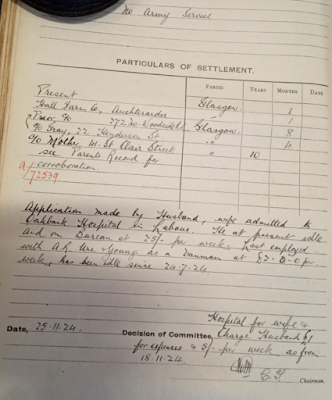
Photo courtesy of Glasgow City Archives

This “Particulars of Settlement” document was a standard part of the poor law paperwork, and it listed the couple’s past addresses - this was to prove they were entitled to receive support from the parish granddad was applying to.  It also conveniently gives the reference number of his own parents’ previous application documents.

Interestingly, among the list of previous addresses – and as this was an application on behalf of my grandmother, she at least would have been living there – was a farm in Auchterarder, in Perthshire.  It isn’t named in the newspaper reports, but I suspect this was the place where the law caught up with granddad – and what on earth was he playing at, dragging my heavily-pregnant grandmother around the country, earning money by picking fruit?!  The schoolhouse he burgled was in the same area, too.  I had a mental image of granny working in the fields while he wore a mask and striped jersey to break in and steal a lady’s gold watch, a rare Indian scarf pin, binoculars, and clothing (according to the Sunday Post).

It’s extremely satisfying when two totally unrelated sources corroborate each other like this.  It also paints a sad picture of life on the poverty line in 1920s Glasgow, although not to excuse granddad’s behaviour, it was a definite red flag. He eventually abandoned his wife and three children (now including my own mother) and left them to look after themselves – which my granny did, and a good job she made of it too.  He played no further part in my family’s life.

There’s another story attached to that aspect of this, but that’s for some other time!

Saturday, 7 September 2019

Doors Open!


5-storey red brick textile mill from outside the gates
Mile End Mill, home to Paisley Heritage Centre

Have you heard of Doors Open Days?  Around the UK, they are held annually, and include many buildings that are not normally open to the public, or which charge entry fees, allow free admission and have special events to mark the day.

This being Renfrewshire’s Doors Open Days weekend, my friend Anne and I visited some of the venues, including Paisley Heritage Centre.  This is housed in a former thread mill, and we were lucky enough to see some of the wonderfully detailed poor law records relating to Paisley residents who fell on hard times in the Victorian era.  Some of these are indexed online, so I had been able to check for ancestors in advance of our visit, which allowed me to identify one individual whose record we viewed - even though the writing posed a bit of a challenge!

1787 Map of Paisley
We were also shown good-sized reproductions of 19th- and early 20th-century maps of Anne’s neighbourhood, and thanks to her local history knowledge she was able to pinpoint familiar landmarks as well as areas which have completely changed since then.  I found some maps of 18th-century Paisley which illustrated the homes of individual families, including some of my ancestors.

It's worth noting that this particular Heritage Centre’s resources are available Monday-Saturday, and not just on special occasions like today.  Community services like these are priceless, and indispensable to family history research.

Parish Church of
Houston & Killellan
We later travelled to the nearby country village of Houston to visit the parish church, and received a lovely warm welcome.  We admired the gorgeous stained glass windows and handcrafted embroidery inside, then basked in the peace and tranquillity of the church’s rose garden of remembrance.  It was extremely tempting to sit there all day, beneath the trees, listening to the birdsong.

Check out your area’s Doors Open Day and take advantage of this once-a-year opportunity to see inside buildings that have special relevance to your family, their work and lives.  Some areas, like the city of Glasgow, have expanded from one day to a festival lasting an entire week, with lots of tours, talks, and exhibitions as well as access to glorious architecture – and that’s coming up in a couple of weeks' time, so plan your visit soon.

Wednesday, 21 August 2019

My Top Family History Discoveries


Scrabble tiles forming the word 'Search'

For this week’s blog post I want to share some of my latest online genealogy discoveries.  They’re all free, searchable websites, and hopefully at least one of them will be of interest and/or use to you in your research.  Do bear in mind, though, that while they’re new to me, they may not be new to you!

So here, in no order of preference at all, they are:

Liverpool as a Trading Port  This site has collected the names of residents of the city from 1704-1860, plus ships sailing from the port between 1759 and 1809.  

Scottish Court of Session Digital Archive  Hosted by the University of Virginia Law Library, this covers the late 1750s to late 1830s. People mentioned in these documents include Scottish women, Virginia merchants, aristocratic Highland proprietors, famous authors, enslaved labourers, soldiers, American Loyalists, and many more individuals who sought justice before the Scottish Court of Session.  Many Scots were merchants and slave owners in Britain and the American colonies. 

Berlin Central Library Collections  These include telephone directories which I used recently to help with relative tracing.  The website is accessible in English (although the records are of course in German).

New Jersey Death Index  Get access to a searchable database of 1,275,833 deaths in the Garden State between 2001 and 2017, and more than half a million digitized death index images for 1901-1903, 1920-1929 and 1949-2000.  

This last one isn’t exactly new to me, but I had forgotten it was available online, and was recently reminded about it by a more on-the-ball frugal friend.  The Scottish poor law records are excellent resources for tracing people who moved about both in and out of the country.  It’s always worth putting in a few of your difficult-to-find ancestors to see what pops.

Index to Paisley Poor Law records 1839-1942  The site gives more information about what to expect from the records and how to access those you find in the index.