Showing posts with label Newspapers. Show all posts

Tuesday, 11 June 2024

This Week's Frugality


Image by Michael Schwarzenberger from Pixabay

Some money-saving suggestions to help you with your family tree:

The Society of Genealogists is offering a free online talk, presented by Else Churchill, on English poll books. 

What are poll books? Find out in an article by Dr James Harris, a Research Associate at Newcastle University. 

Legacy, part of the company MyHeritage, offers a new version of its free family history software to help you organise your tree, store it on your device, and keep it private if you wish. There are a number of other packages available; check out reviews in family tree magazines for up-to-date details about the latest programs.

The National Library of Scotland’s digital “Scotland’s News” Collection consists of 18th, 19th, and early 20th century Scottish publications. Some of the newspapers it contains are the Scots Courant, Caledonian Mercury, Clydebank Leader, and a selection of 1926 titles from around the country.

I’ve recently been in touch with a cousin who has agreed to take a DNA test to find out more about their forebears. It can be helpful if more than one member of an extended family tests – learn more about Connecting with Your Biological Family.

At the moment, you may be able to take advantage of discounted prices on some DNA test kits. The best value as far as I can see are

Ancestry 

and

MyHeritage 

These companies market DNA test kits as Father’s Day gifts. Warning: unexpected parent details may be the result, not necessarily bringing great news to an unsuspecting dad. I think it’s really important to be aware of the potential downsides to these tests’ results. Read about the Pros and Cons of DNA in Genealogy Research


Monday, 23 May 2022

A Miscellany of Free Genealogy Stuff


Another in my series of occasional round-ups, sharing some news and new finds in the world of online family history.

Ancestor Abel 

A good alternative to GENUKI for Scottish research is Ancestor Abel, compiled by Dr John Robertson. It lists each parish and its extant records and other sources of genealogical information, with links to them where applicable. Some of the links to external sites are no longer working; for example the Angus Folk Museum in Glamis ceased to exist several years ago and the link now simply takes you to the National Trust for Scotland’s main site.

FindMyPast    

The subscription website offers more than a million pages from their newspaper collection free of charge. Of course, this is to tempt you into paying for full access to their entire 50 million pages. Be strong!

Gigatrees  

This is a free application that allows you to build an online space for your family tree, blog, or photographs. You don’t need any programming or web-building skills, and there’s a quick start guide to get you going.

Legacy Family Tree

The family history video host is holding a one-day conference this Saturday (28th May), offering free access to some of their recorded presentations. This month the theme is German research.

Tuesday, 26 April 2022

On the trail of my military McIntoshes


Siege of Burgos, 1812, Francois Joseph Heim (Public domain)

In search of my several-greats grandfather who fought at Waterloo – and who carried his wounded brother on his back on the retreat from the siege of Burgos in the Peninsular War, only to discover when they got to safety that his brother had died – I recently contacted the Black Watch Museum Archives in Perth (the Scottish one) to find out if they had any regimental records that might help identify said brother. I had previously been unaware of any siblings that great-grandpa Hugh had. 

Hugh was born in either Avoch (pronounced “Auch”) or Rosemarkie, depending on whether you believe the census or the military records. As they’re only a few miles apart it doesn’t really matter; both are in the area of Easter Ross known as the Black Isle, and neither of their parish churches’ records include a birth record for Hugh.  There are over 50 individuals with the surname McIntosh in the 1841 census taken in Avoch. Hugh isn’t one of them, however, as by that time he had retired from his military career and set up home in Nairn, on the other side of the Moray Firth, where seven of his nine children were born to him and his wife Elizabeth Sinclair.

He had more than likely been stationed at nearby Fort George during his service, as it was there, in the parish of Ardersier, that he and Elizabeth were married. Perhaps that was part of the reason for choosing Nairn as their home, after a life in the army.

I was delighted, then, to receive an email last week from the Black Watch archivist, Jennifer, who had made a search of the records they held and had not only found records that mentioned Hugh, but had managed to narrow down the identity of his brother, using a casualty list and other regimental records.  The only McIntosh who was in the same unit as Hugh and who died in the retreat from Burgos was named Donald. As he didn’t survive there won’t be any discharge or pension records at Kew, unfortunately.  But now that I know his name, it won’t be quite as much of a needle in a haystack task to find out more about him; perhaps in newspapers, or a local war memorial of some kind.

I don’t know whether the McIntoshes moved en masse from the Black Isle to Nairn, or if it was only Hugh who settled there.  It’s possible that Donald was born elsewhere in Scotland.  Hugh’s first two children were born in, respectively, France and Dublin, Elizabeth accompanying him both on campaign and in his postings.

Both Hugh and Donald are listed in this roll of Capt. James Stirling's Company

My next goal is to identify which of Hugh and Elizabeth’s five sons were also in the army.  His obituary mentions two, and gives their regiment and the places around the world in which they served.  So far I've found one described as a “pensioner” in his own newspaper death announcement. Sadly, he also appears to have had a lengthy and varied criminal record, with his name popping up regularly in the burgh police records and the court reports of the local Gazette. One can only imagine the possible PTSD that led him into such a life. It's his pension record that I'm going to try and find next.  Stay tuned for (hopefully) more finds!

Oh, and here's the newspaper obituary for Hugh which set me off on this chase. He was a bit of a character.

Nairnshire Telegraph, 4 February 1863 (courtesy of BNA)


Tuesday, 19 October 2021

Putting the Pieces of the Puzzle Together


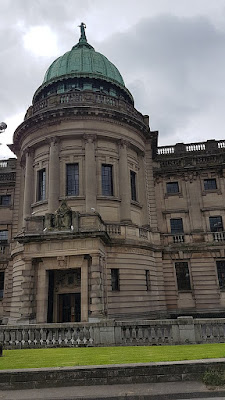
Mitchell Library, Glasgow
(PC: Stinglehammer, CC BY-SA 4.0 via Wikimedia Commons)

Some of the most useful record sets in Scotland are poor law application forms. Glasgow’s collections of these are the most extensive (over a million records) and are name-indexed on a computer database held in Glasgow City Archives at the Mitchell Library.

I’ve been using these fantastic records for many years now, and I tend to forget that more are being added each year, as they're released from the closure period (75 years for adults, 100 for children).  So I was surprised to find a record of my grandparents applying for help from the parish in 1924 – not that their circumstances were unexpected, just that I hadn’t realised enough time had elapsed for their records to be available!

This was the same grandfather who I last year came across in the British Newspaper Archives’ collection – completely by accident, as his combination of names runs through several generations of the family – and was stunned to learn that he had been caught red-handed with the proceeds of a burglary, taken to court, and ended up in prison.  The newspaper accounts gave enough detail for me to know that he was working away from home at the “berry picking” on a farm in Perthshire, and had been trying to pawn one of the “hot” stolen items in Stirling.  Police followed his trail to the farm and arrested him, and he was tried at Perth Sheriff Court and sentenced to fourteen days in jail.

Strangely enough (!), he does not mention any of this in the poor law application on my grandmother’s behalf, made just a few months later.  He surely knew that if he confessed to any of the above, the inspector assessing his case would be much less likely to look favourably upon his application for parish support.  Already noted as being against him were the fact that he hadn’t served in the army, and was currently “idle” i.e. out of work and claiming unemployment benefit.

The reason for the application was that my grandmother was in labour with her second child and they couldn’t afford the medical fees, this being in the days before the National Health Service.  Granddad made his request for assistance at 5.40am on the morning of November 18th, 1924, and the documents confirm that the baby was born later that day in Oakbank Hospital in the north of the city.  A note at the foot of the page below shows that he was expected to pay £1 for the medical treatment, in weekly instalments of five shillings.
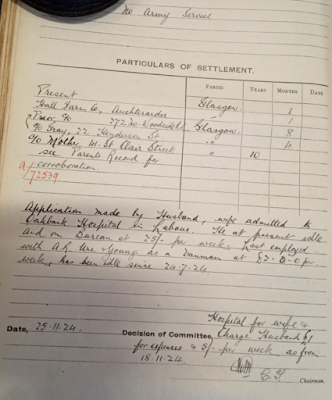
Photo courtesy of Glasgow City Archives

This “Particulars of Settlement” document was a standard part of the poor law paperwork, and it listed the couple’s past addresses - this was to prove they were entitled to receive support from the parish granddad was applying to.  It also conveniently gives the reference number of his own parents’ previous application documents.

Interestingly, among the list of previous addresses – and as this was an application on behalf of my grandmother, she at least would have been living there – was a farm in Auchterarder, in Perthshire.  It isn’t named in the newspaper reports, but I suspect this was the place where the law caught up with granddad – and what on earth was he playing at, dragging my heavily-pregnant grandmother around the country, earning money by picking fruit?!  The schoolhouse he burgled was in the same area, too.  I had a mental image of granny working in the fields while he wore a mask and striped jersey to break in and steal a lady’s gold watch, a rare Indian scarf pin, binoculars, and clothing (according to the Sunday Post).

It’s extremely satisfying when two totally unrelated sources corroborate each other like this.  It also paints a sad picture of life on the poverty line in 1920s Glasgow, although not to excuse granddad’s behaviour, it was a definite red flag. He eventually abandoned his wife and three children (now including my own mother) and left them to look after themselves – which my granny did, and a good job she made of it too.  He played no further part in my family’s life.

There’s another story attached to that aspect of this, but that’s for some other time!

Monday, 5 July 2021

Free resources from home, via your public library


Although many libraries are starting to re-open after an extended shutdown, they may still be offering free home access to internet resources by way of compensation for the closure.  These often include subscription websites that are of interest to family historians.

All that’s needed is an online account with the relevant library.  Check your local library’s website for information about the services they are making available remotely to their members. You may need to re-register online to take full advantage of their free resources, which could include one or more of the following:

Ancestry has a Library Edition which has proved a popular choice with public libraries.  Some services, such as those in Manchester and North Lanarkshire, have also partnered with Ancestry to give readers free access to records local to their areas, such as church or poor relief registers.

FindMyPast provides a similar service through some libraries’ websites.

SCRAN is a website from Historic Environment Scotland hosting audio and visual resources from museums, galleries, archives and the media around the UK.

Oxford Dictionary of National Biography gives full access to subscribers, including those signing in with their local library’s credentials. 

For some of these websites, you can access their full content through a link on their home page that says something like “Sign in via your institution”.  Select your library’s name from the list that will appear (if you don’t see your library listed, it doesn’t provide access to that particular resource).  You will then be able to sign in with your own library account number and passcode.

A multitude of digital resources are available at home, free of charge, to all residents of Scotland, through the National Library’s website.  They include several newspaper databases such as the Times, the Scotsman, and the British Library Collections, as well as the excellent British Newspaper Archive.  Some of the sites restrict the number of NLS users that can access them at one time, but these are clearly indicated on the list of websites.  

Normally you would need to either have your own subscription or a university library account to use many of these resources, so it is well worth registering for an NLS account if you live in Scotland.  If you don’t live in Scotland, though, don’t despair; many of the Library’s online treasures are free on the open web, such as their Maps collection or the Moving Image Archive. 

Finally, if you’re disappointed with the lack of such resources through your local library, why not petition the powers that be to provide them?  You can find information online about products such as FindMyPast’s Community Edition, and pass on your suggestions to a librarian.  Alternatively, if you use and are happy with your library's digital services, give them positive feedback and encourage them to continue providing remote access after normal opening hours are resumed.  This may be especially important if library services are considering cutting back opening times in the near future.

Friday, 22 January 2021

Free Scottish resources: Happy Burns Night!


Burns Monument Centre, Kilmarnock

To celebrate the birthday on January 25th of Scotland’s national bard, Robert Burns, I’ve put together a selection of free websites that may help you to grow your Scottish family tree a bit.

Ayrshireroots  Lots of links to explore including maps, reference books, and a surname database for the parishes and towns of Burns' native county.

Glasgow Valuation Rolls,1913-1914  Learn about and search these lists of Glasgow owners and occupiers, with the value of their properties, to locate your early 20th-century relatives living in the city.

SCAN – Scottish Archive Network  Identify useful genealogical sources using a keyword search of over 20,000 historical records in dozens of Scottish archives.

Statistical Accounts of Scotland 1791-1845  Background information for the entire country, parish by parish, in the 18th and 19th centuries.  These books were compiled from contemporary accounts written by locals about their own area, with descriptions of the parish, its history, its natural features and industries.  Excellent for learning about the times and places your ancestors lived in.

Scots Abroad  Whether your relatives went abroad to work, live, or visit, they may appear in these databases hosted by the National Library of Scotland.  These include correspondence from emigrants and guides for those planning to emigrate to different parts of the world.  Get a flavour of what life would have been like for people making their first trip away from Scotland.

Scottish Emigration Database  Search by the name of a person or the ship they sailed on. Thousands of entries from 1890 to 1960 list the address from which they were emigrating and their destination overseas.

And of course, a post about Burns Night wouldn’t be complete without a link to

Happy Haggis which has a great index to over 30,000 historical newspaper articles from 1848 to 1854, covering that crucial period just before civil registration began in Scotland.

Enjoy exploring these websites as you nibble on your Scottish treats or haggis-flavoured crisps and sip your choice of national drink.

Photo by Brett Jordan on Unsplash


Wednesday, 26 August 2020

Free Family History Mini-Class : Lesson 8

Woman reading tablet


In our digital age, many otherwise inaccessible historical sources and information are readily online, not just to read, but to search using keywords and names.  You’ll find that they are often provided in formats (such as PDF files) which can be downloaded to a mobile device for use on the go.

Digital resources are an indispensable element of the genealogist’s toolkit, and even more so when access to physical archives and libraries is limited.  Check out the following links, and hopefully you’ll identify sources that you can use in your research.  All of these are free to access.

Books
HathiTrust hosts millions of digitised books from libraries the world over, while
Project Gutenberg has free e-books of many classics and out-of-copyright titles.

Newspapers
Read my previous blog posts here and here for details of some of the essential free newspaper archives online.  Don't overlook these invaluable records of your ancestors' everyday lives.

Historical city & trade directories
Scottish Post Office directories list names, addresses, and trades or occupations of people in urban areas from the 18th century onwards. 
For England & Wales, there are similar Trade & Local Directories from the 1700s to the 1910s.

Area histories
To learn more about the local history of specific counties or parishes, there are the Victoria County Histories covering England, and for Scotland, the 18th- and 19th-century editions of the Statistical Accounts

Digital Collections 
Such resources include many images that can bring your family’s history to life.  These are just a few suggestions.

SCRAN offers still, sound and moving images from hundreds of museums, including the Victoria & Albert and National Galleries of Scotland.  View buildings where your ancestors lived, worked, or went to school, objects they might have used, and views they would have looked out on.

The British Library's digital collections include illuminated manuscripts and vintage books with photo-illustrations, which could easily side-track you en route to their wide selection of online maps, or their oral history recordings.

Ireland
Fordham University in New York City provides an extensive list of links to free digital content from Irish libraries, archives and museums, including many sources of use to family historians.

United States
The US Library of Congress’s vast range of subject matter, from music to maps, includes local, social, and business history collections in different formats.  The America at Work, America at Leisure: Motion Pictures from 1894-1915 collection is just one highlight of a fascinating online repository.

The next class will introduce you
to some essential reference tools
for family history research.


Thursday, 20 February 2020

Killing Off Ancestors From the Comfort of Home, Part 2


Inkpot, pen, and folded legal document

In Part 1 I covered death certificates, church death and burial records, interment registers, and monumental inscriptions – all great sources for identifying when and where your forebears died.

Here, in Part 2, I’ll discuss a few more tried and trusted methods of locating your ancestors who have gone to join the choir invisible.

First of all, probate records.  In order for heirs to inherit property, many legal systems require a written record; this is called a will, or a testament in Scots law.  Also included may be an inventory of the deceased’s moveable possessions.

To find testaments or inventories of someone dying in Scotland, search the free index at ScotlandsPeople (1513-1925).  The results provide details of the deceased, such as their occupation or residence, which may help narrow down your search. 

Probate records at the National Archives of Ireland’s website are grouped into three sections: Prerogative and diocesan wills 1596-1858, Calendars of wills and administrations 1858-1922, and Will registers 1858-1900 

In England and Wales, the majority of wills were administered by the Church of England’s Prerogative Court of Canterbury from 1384 to the beginning of 1858.  You can learn about these documents and how to access them online at The National Archives.  Their index is free to use (charges apply if you wish to download a copy of a will, although they are free to view onsite at Kew). 

Probate records from around the world can be found via FamilySearch – tick the “Probate” box and any other options which would help your search.  Images of many records are available, and all are free to view.

FamilySearch record search page, world map


At home, you might find funeral-related documents among the family papers: undertakers’ bills, memorial programmes, mourning cards, etc.  Other useful items could include military memorabilia such as telegrams or paybooks.  For British and Commonwealth forces, not only burial locations and photographs but grave registration, headstone, and other documents can be found in individual entries at the Commonwealth War Graves Commission’s website.

Newspaper family announcements can be a valuable source of information when tracking down deceased relatives, particularly in more recent times when online tributes are becoming popular.

A few examples of these are

For earlier centuries, the official UK government newspaper, the easily-searched Gazette (and its regional editions) carried family and probate notices, as well as military promotions.  PDF images of its pages can be viewed and downloaded.

Also check out my two previous posts on free searchable newspapers:

Saturday, 11 January 2020

The Sensational and the Factual


Engraving of the Victorian London skyline including St Pauls Cathedral

Back in May last year, I wrote a post covering a few free online newspaper websites (you can see it here).  The other day I noticed one of the subscription newspaper services promoting their access to the Illustrated London News, and I thought, “That’s odd, I was sure there was a free website for that.”  

And, indeed, there is: John Weedy’s Collection of the ILN from Victorian times to 1973.  Browse his site to experience the sensational and the factual.  Listed for each issue are headlines, sometimes obituaries, fascinating cover pages and other illustrations. You can also choose a specific year to explore using the grid section of the page. 

This led me to revisit the free newspaper sites I have bookmarked on my web browser, some of which I've listed below.  Then as now, journalists wrote and published stories from around the world, so you shouldn’t dismiss searching for your relatives in newspapers from other countries  you could find them mentioned in the last place you’d expect. 

📜 Papers Past – the website of the National Library of New Zealand, which contains not only newspapers but magazines, journals, letters, diaries, and parliamentary papers.  Search using your own terms, or explore by title or region.

📜 Trove –  hosted by the Australian National Library.  I covered this site in last year’s post, and yesterday they posted an appeal for help in correcting the text in their online news collections.  Since much of the indexed text has been interpreted by computer, there are errors that will be obvious to human eyes and easy to edit.  This is a great way to “give back” to the research resources you enjoy at no cost, as it will increase the accuracy of search results.  Learn more about the project here

📜 Chronicling America – the United States Library of Congress hosts digitised newspaper images from 1789 to 1963.  These are searchable by keywords, dates and states, or if you know the name of the newspaper, by title.

📜 Old Fulton New York Postcards – despite the name, this low-tech site covers newspapers from the U.S. and Canada for 1795-2007.  Enjoy listening to some vintage radio drama while you search the site, and be sure to peruse the Help page, which also includes a link to let you browse the historical photos and papers that the site holds.

I couldn’t finish this whistle-stop tour of free newspaper collections without mentioning the fantastic services provided by public libraries and archives around the world.  If you like nothing more than leafing through the original newspapers your ancestors would have read, this is a superb option.  Contact your nearest library or record repository to find out about their hard-copy collections.

Wednesday, 22 May 2019

Read All About It!


Front page of 1893 issue of Glasgow Herald newspaper
From Google Newspaper Archive

In the days before the Internet (remember them?), a key source of family history information was newspapers, particularly local ones that published announcements of births, marriages and deaths.  Nowadays, such proclamations are often made on social media, and you are more likely to find out about the latest addition to your family via Facebook than by a notice in the paper.

However, our ancestors were firmly in the analogue age and not only used newspapers to communicate life events, but may have featured in articles about their achievements, successes, and perhaps even notoriety.  Depending on the publication and date, you may find information about your relatives’ exams, graduations, military career, court appearances, community service, employment and more.  You may even come across photographs of family members as they celebrated wedding anniversaries or were involved in important local events.

But, you may say, how does that help when I live too far away from my ancestors’ home town to visit their local newspaper archive?  This is where the Internet comes in.  One of the best online free sources is Google Newspaper Archive which holds digital images of the original publications.  It covers many areas of the world and you can search the whole archive by keyword, such as the town or county of interest, or the name of your ancestor if it was sufficiently unusual.  I tend to identify a town, select a newspaper title and narrow down through the decades, months and weeks to a date range where there may be a reference to a family member.  If, for instance, your relative was a clergyman, you might find him mentioned many times in family announcements as well as in reports of parish meetings and church events.

Other free online newspaper archives include

·       The Gazette – a UK official government publication beginning in 1665. This includes reports of bankrupts, civilian and military awards, marriages, and wills.
·       Trove – a searchable Australian collection of digital images.
·       Welsh Newspapers Online – National Library of Wales’ online archive of 15 million articles.
·       National Library of Scotland eResources – these include many digitised newspaper collections. Free registration allows Scottish residents to search and view images.