Showing posts with label Research methods. Show all posts

Thursday, 19 December 2024

Henry Wyatt & the Good Templars

In Memoriam. The late Bro. Henry Wyatt. A photograph of an elderly Victorian man with mutton chop whiskers, dressed in a black suit and white shirt, with small black tie
Obituary, The Good Templar

A few weeks ago, in the Scottish Indexes online conference Q&A session, a viewer asked about sourcing records for the temperance organisation, the Good Templars.

I was surprised, but happy to answer the question, because some years ago, I researched a family whose father was a member of this Victorian order. Plenty of information about the family, the Wyatts, had been forthcoming from the usual BMD and census records, and more was to be discovered in Post Office directories, electoral rolls, journals, and newspapers - all from the starting point of the newspaper announcement where I came across the Good Templars for the first time:


Glasgow Herald, 27 November 1899


Not having realised that Henry was part of something bigger, I researched the Good Templar organisation at Glasgow's Mitchell Library and found that they held a run of Good Templar journals. Here I was astonished to see the picture of Henry (at the head of this article) staring back at me from his obituary.

Born in the parish of Holborn, London around 1824, according to census returns – although the church records of the parish haven’t yet yielded up any proof of this – Henry Wyatt arrived in Glasgow in the late 1840s. He and his wife, Sarah Ann Reynolds, had seven children, all born in Glasgow between 1847 and 1858: Joseph, Benjamin, Mary Jane, Elizabeth, Emily, Sarah Ann, and Margaret. The family seemed to be attached to the Episcopal Church in the heart of the city, St Andrews by the Green,1 where four of their first five babies were christened. The one exception, Elizabeth, was taken to Christ Church in Bridgeton, an East end Episcopal church, for her baptism, while the next child, Emily, was brought to St Andrews to be christened. Whether this back-and-forth was due to the usual church being temporarily out of commission, a relative’s choice, or a preference for a specific clergyman, is still not clear.

A modest-looking 19th century church built of pale stone, with no spire or steeple

Former church of St. Andrew's-by-the-Green, kim traynor, CC BY-SA 2.0


In 1855, Henry’s father Benjamin travelled to Glasgow from England. Widowed when Henry was a boy, Benjamin had remarried in 1831 in Liverpool, and it was there that his second wife had died in the summer of 1854. It’s unclear whether he planned to remain in Glasgow with Henry, because a month after his arrival, he died after suffering from gastritis for eight weeks. This would have been a devastating blow to his family as he was only 54 years old; however, the date of his demise was a big genealogy plus, as this was the year in which civil registration had been introduced in Scotland. For just 1855, extra details were included in birth, marriage, and death records, meaning that a lot of information was gleaned about the Wyatt family.

Henry registered his father’s death, and the certificate recorded all of the following: Benjamin had been born around 1802 in London and had been married twice. His first wife was Henry’s mother, Mary Soliman, and together they had four children: Caroline, born about 1820, Susanna, who died in 1822 aged 1, Emma, born 1824, and Henry. Benjamin’s second wife was Frances Higham (their marriage produced no children according to the certificate) and his parents were named as Edward Wyatt, a lamplighter, and Susan, whose maiden surname was unknown. This proved a great foundation on which to build the structure of the family, chasing up and trying to confirm (or otherwise!) all these details.

It later came to light that Caroline also moved to Glasgow, was married, and lived to the splendid old age of 96.

Henry continued to earn a living by various means, as indicated in the census. His occupation was listed as, from 1851, a clothes broker and a general dealer, and by 1871 he had become a hotel keeper. This may have been precipitated by his sequestration that March, as recorded in the Edinburgh Gazette: “The Estates of Wyatt & Company, Furnishing Warehousemen in Glasgow, and Henry Wyatt, Furnishing Warehouseman in Glasgow, the sole Individual Partner thereof, as such Partner, and as an Individual, were sequestrated on the 3d day of March 1871, by the Sheriff of Lanarkshire."2 How he managed to get back on his feet in such impressive style, I was never able to discover!

Among all this wheeling and dealing, in 1867 Sarah Ann died at the relatively (even for those days) early age of 41. The cause of death on her burial record is noted as “Debility”, an unsatisfyingly vague description. Four months later, Henry married Mary Mitchell, seventeen years his junior and the daughter of Irish immigrants. Records don’t show them having any further children, but Mary would have had her hands full anyway, with all five girls still living at home, ranging in ages from 9 to 16.

In the 1871 census Henry’s home address was given as 63 Candleriggs, and this was also the location of one of his hotels. As can be seen in the advert below, he was by now involved with the Good Templars and operated his establishment as a temperance hotel.3 This was an idea begun by the abstention campaigner Joseph Livesey in the 1830s. It was intended to provide a "dry" alternative to the ubiquitous availability of alcohol in lodging-houses and inns, in an effort to check the spread of drink-related social issues in Britain.4


Wyatt's Commercial & Good Templars' Hotel, 63 Candleriggs Street, Glasgow. Plain Breakfast 9d; with Eggs, 1s; with Ham and Eggs, 1s 3d; with Steak or Chop, 1s 6d. Beds, boots, and attendance, 1s 6d. Commercial room, and ladies’ private sitting room. First-class accommodation.  Post Office Directory advert, 1875.
Post Office Directory advert, 1875

The temperance movement used a variety of methods to appeal to people and convince them of the evils of “the demon drink”, and Henry seemed to be deeply committed to this cause. He had become a member of its “Scotland’s First” lodge soon after it was set up in Glasgow, in August of 1869, at a meeting of the United Working Men’s Total Abstinence Society.5 Its fraternal nature was similar to that of the Freemasons and other groups who claimed good works as their main focus, although the Templars also admitted female members.

Henry’s daughter Sarah Ann was recorded as working as an assistant manager in the Candleriggs location. The Wyatt temperance hotels expanded to include two more in Glasgow, in nearby Brunswick Street and in Dundas Street, and eventually one in the Ayrshire coast town of Prestwick.

His obituary outlined the work Henry carried out in support of the temperance movement: “For many years he was a fearless champion of the cause. He conducted Temperance meetings on [Glasgow] Green with much acceptance. His genial, happy manner carried conviction, and led many to sign the pledge.”6  This referred to the abstinence pledge that temperance workers encouraged everyone to take, swearing off alcohol for life.


Uxbridge Temperance Hall. The Universal Organization of Good Templars Pledge. “You, in the presence of Almighty God, and of these witnesses, solemnly and unreservedly promise that you will never make, buy, sell, use, furnish, or cause to be furnished to others, as beverage, any Spirituous Liquors, Wine or Cider and that in all honorable ways you will discountenance their use in the community.” 19th Century Canadian Good Templar Pledge.
19th century Canadian Good Templar Pledge


Things appeared to be going well for Henry in the 1880s, but this wasn't to last. Further bankruptcy proceedings were initiated in 1887, with Henry being described as a "hotel proprietor dealer in furniture". He clearly enjoyed having more than one string to his bow, but perhaps this caused him to overextend financially. A few years later he was still operating the hotels in Brunswick Street and Dundas Street, as well as a restaurant next door to the latter.7

By the end of the decade he had relocated himself, wife, and business to Prestwick. He transferred his Good Templar membership to the local “St Nicholas” lodge and continued his association with the temperance cause. Unfortunately financial ruin continued to dog his footsteps, and an article in the Glasgow Herald in November of 1897 reported Henry’s detailed account of his hotel businesses and family assets. He was 73 by this time and not in good health, being unable to read handwriting (as opposed to printed matter) and therefore his bookkeeper’s ledgers.8

The strain of this had possibly led to this blot on his copybook, just a few months previously9:
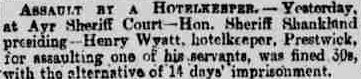

Newspaper article: Assault by a hotelkeeper. – Yesterday, at Ayr Sheriff Court – Hon. Sheriff Shankland presiding – Henry Wyatt, hotelkeeper, Prestwick, for assaulting one of his servants, was fined 30s, with the alternative of 14 days’ imprisonment.

I would hope that he was able to take the fine option...

On the 24 November 1899, Henry died at his home, South Lodge in Prestwick, of dropsy – a term used to describe the symptoms of what was often heart failure.10 His obituary referred to his “lengthened illness”.

Henry was buried in Glasgow, in the Southern Necropolis, and his funeral was conducted by his fellow Templars.11  It was this obituary, published in the Good Templar journal, that allowed me to learn about his service in the temperance movement, so I suggested these journals to the researcher who was looking for records. I neglected to tell her that the Templars' Scottish records are held at Glasgow University Archives - perhaps I should take my own advice and visit them to learn even more about Henry!


1 St Andrews by the Green Episcopal Church, Glasgow, Ref. TD243, Glasgow City Archive.

2 Edinburgh Gazette, 7 March 1871, https://www.thegazette.co.uk/Edinburgh/issue/8143/page/176.

3 Post-office annual Glasgow Directory, 1875-1876, https://digital.nls.uk/directories/browse/archive/84188037.

4 Helensburgh Heritage Trust, Temperance hotels were popular, https://helensburgh-heritage.co.uk/index.php.

5 Records of the International Order of Good Templars: Grand Lodge of Scotland, held at University of Glasgow Archive Services, https://archiveshub.jisc.ac.uk/search/archives/012fd6d2-c9e9-3cca-9807-aa919bf43c22

6 The Good Templar journal, c. 1900, Mitchell Library, Glasgow.

7 Post-office annual Glasgow Directory, 1897-1898, https://digital.nls.uk/directories/browse/archive/85331301.

8 Glasgow Herald, 27 November 1897.

9 Glasgow Herald, 12 August 1897.

10 “Dropsy,” University of Leeds Library Special Collections, https://library.leeds.ac.uk/special-collections/collection/2156.

11 The Good Templar journal, op. cit.


Wednesday, 1 March 2023

RootsTech 2023: Online and In-Person


This year, the RootsTech genealogy conference has morphed from its last two years’ online-only format into a hybrid event, meaning in-person attendance is now possible as in earlier years.  The significant online element has widened the event’s reach and made it more inclusive to those around the world for whom a trip to Salt Lake City is out of the question.  It also means that speakers don’t need to be on the ground at the conference, either.

Which is why for the third year running I’m able to contribute to the hundreds of video classes showing from 2nd of March onwards (or 11pm on the 1st if you’re in the UTC time zone).  This year, I’m giving the following presentations:


10 Sources for Researching Your Scottish Ancestors - Without Certificates

Learn about the best resources to use to track down your Scots ancestors when birth, marriage, or death certificates aren't available, or are hard to find. Many of these resources are free to use.


Frugal Family History - Tips for Tracing Your Family Tree on a Budget  

Tracing your ancestors need not be an expensive activity. Learn about many of the free resources that can be drawn on to grow your family tree.


Killing Off Your Ancestors - 10 Sources for Identifying Deaths  

Even though your ancestors may have lived long ago, finding out about their deaths can teach you a lot about their lives. Discover the many sources of information which will shed light on this important part of their history.


These videos will be available for at least twelve months, alongside my previous presentations for RootsTech.  You can find them all at 

https://www.familysearch.org/rootstech/speakers/alison-spring/en

Each talk has an accompanying syllabus or handout which you can download from the same RootsTech page as the video, containing links to the websites I refer to.

Do get in touch with me if you have any questions about any of these RootsTech talks.


Wednesday, 1 June 2022

Graveyard Research: Planning & Visiting

Glamis Kirkyard

In this post, I want to share some resources to help you plan and carry out research visits to graveyards.

For those working out of doors in Scotland at this time of year, the most important item to pack is

MIDGE REPELLENT

A few years ago, a nurse gave me a tip that has worked for me.  Dilute a small amount of Listerine mouthwash in a spray bottle and apply to exposed skin (yours, not the midges’). Frugal and effective!


Planning

For identifying historic graveyard locations, I recommend the National Library of Scotland’s Maps (their OS collections cover the UK).

The Ordnance Survey (the official UK Government mapping organisation) provide free access to contemporary maps, as well as an app to purchase for your mobile device, with a free 7-day trial.

Current online maps provided by popular search engines like Bing and Google are not always accurate or up to date.  This report about Google Maps' dangerous path up Ben Nevis highlighted the potential hazards of relying on this kind of source. 

GENUKI may give names and/or locations of burial grounds in a parish or county you are researching.  Again, check that the information is current (especially crucial details like opening hours) by contacting the local church, council, or family history society. Their contact details may also be found on GENUKI or, for the latter, through the Family History Federation or the Scottish Association of Family History Societies.

While websites such as BillionGraves or FindAGrave won’t necessarily list your ancestors, they may have an entry for the graveyard(s) you’re interested in, with the all-important location details, including GPS coordinates.


Arriving

“Leave nothing but footprints” is a phrase often used to raise awareness of the potential impact we can have on the countryside.  I’d suggest that we adopt a similar approach to visiting cemeteries whether in town or country.  These spaces are often havens for wildlife and need to be treated with care, as well as the respect due to burial grounds in general.

I would advise you to choose footwear appropriate for rough terrain, especially if you aren’t familiar with the cemetery.  Some graveyards may suffer from subsidence and require caution while navigating around.  Many cemeteries are neglected and overgrown, and while I'm not advocating the use of machetes, sensible clothing is definitely advisable!


Recording

Decide in advance which method(s) of recording gravestones you’ll use, and bring the appropriate kit.  Hidden Heritage has some great ideas for non-invasive techniques, including a link to free imaging software and how this can help make inscriptions clearer. 

To preserve the fabric of headstones, use contactless methods to take a note of monumental inscriptions.  Pen and paper or photographs may be old-fashioned but they’re reliable and good for the stones.  Digital photography and smartphones have transformed our ability to take multiple images of a gravestone and its surroundings, and to share and store them online.

Historic Environment Scotland has produced a PDF leaflet, Looking After Gravestones, which has some excellent advice about the treatment, care and preservation of cemetery monuments.


Searching

While some burial grounds may have plans or maps available, either online or in the cemetery itself, it can still be difficult to locate a specific burial site, even if you have a plot number.  Do ask for help if local staff are available.  Those tasked with keeping the grounds in good order will be very familiar with the chronology of the place as well as the location of some of the occupants.

If you have a plot or lair number for the grave you want to see, these are sometimes carved into the side of the headstones in larger cemeteries, and while your family stone may not have one, the surrounding stones might.

Once you have found the grave(s) you’re looking for, check nearby for potentially related memorials.

My perennial graveyard tip: look on the reverse of the headstone (just in case they ran out of room on the front). I found an example of this on a recent churchyard search near Forfar.


Check out another of my posts for more tips
 on graveyard research.  Happy hunting!

Monday, 23 May 2022

A Miscellany of Free Genealogy Stuff


Another in my series of occasional round-ups, sharing some news and new finds in the world of online family history.

Ancestor Abel 

A good alternative to GENUKI for Scottish research is Ancestor Abel, compiled by Dr John Robertson. It lists each parish and its extant records and other sources of genealogical information, with links to them where applicable. Some of the links to external sites are no longer working; for example the Angus Folk Museum in Glamis ceased to exist several years ago and the link now simply takes you to the National Trust for Scotland’s main site.

FindMyPast    

The subscription website offers more than a million pages from their newspaper collection free of charge. Of course, this is to tempt you into paying for full access to their entire 50 million pages. Be strong!

Gigatrees  

This is a free application that allows you to build an online space for your family tree, blog, or photographs. You don’t need any programming or web-building skills, and there’s a quick start guide to get you going.

Legacy Family Tree

The family history video host is holding a one-day conference this Saturday (28th May), offering free access to some of their recorded presentations. This month the theme is German research.

Tuesday, 5 October 2021

Genealogy Extras: Free Course & Free Conference!


More great learning opportunities are being offered all over the genealogy community - here are just two to keep you occupied!

The free online 6-week course run by the University of Strathclyde, “Genealogy: Researching Your Family Tree” is starting on 18th October.  Register soon as places go fast on this course, even though it runs more than once a year. 

Centred around a real-life case study, the course allows you to work through the materials at your own pace, and discuss related questions and issues with other participants from across the world.  As well as explaining key record types, you will discover how DNA fits in to modern family history research, and learn about different ways to record, organise and share your genealogy.

Also worth checking out is the recent conference of the Register of Qualified Genealogists.  Many of the presentations from this excellent event were recorded and can be viewed until 31st October.  Just a few of the talks on the programme are

  • Jilted! Or the insights offered in a breach of contract of marriage cases
  • Hidden History: Tales of everyday life in Newspaper Advertisements
  • Life of the Early Victorian Deaf & Dumb
  • Dusting & Digging: The Work of Women
  • Lying Bastards: the impact of illegitimacy on family history research
I thoroughly enjoyed all these presentations, which were highly entertaining as well as informative, and came away with plenty of ideas to further my research.

Tuesday, 24 August 2021

What Was Your Ancestor's Job?


Work, Ford Madox Brown, Public Domain

A whole new route of ancestral exploration can be opened up if you know what your relative’s occupation was.  Many of mine were “ag labs” or crofters, and there is, as far as I know, no comprehensive list of everyone in those lines of work, but when they were nurses, weavers, clergymen, police officers, or miners, I might have better success.

Many libraries, archives, and historical societies maintain occupation-specific lists or indexes of local people, such as Renfrewshire Heritage Centre’s collection of Paisley weavers, hammermen and tailors’ records.  

Glasgow City Archives holds a computerised database of police officers' service records up to 1939.  The records themselves include information about the officers and their families.

Other sources are freely available online, and hopefully one or two of my suggestions here will give you some ideas to pursue.


Specific occupations

One resource that has been useful for my research on a couple of branches of the family is the Clergy of the Church of England Directory, 1540-1835.  This reference tool not only lists ordained clergy, but also shows the chronological order in which they served in each parish – in effect, providing a bit of history for the area, too.

Meanwhile, the Scottish Book Trade Index provided a ready-made career timeline for my 3rd great-grandfather, Thomas Paterson, a lithographic printer in Glasgow.  Anyone in the Scottish printing or publishing trades, including booksellers, stationers and papermakers, may be listed here.

If your relative operated their printing or publishing business in England or Wales, the British Book Trade Index, hosted by the Bodleian Library, covers similar occupations up until 1851. 

Working on the railways has always been a hazardous job, and the Railway Work, Life & Death website has for some years been compiling a database of those who met with accidents in the course of their railway occupations.  This covers Britain and Ireland from the late 1800s until the Second World War.

House historians as well as genealogists may find the Dictionary of Scottish Architects 1660-1980 valuable.  It gives biographical details plus a list of the known works of each architect in Scotland, and in turn a history of each of their buildings.  For instance, the entry for Glasgow School of Art has a chronology showing events in its history, from the 1896 competition held for its design until an award for its lighting in 1990.  A list of the unsuccessful competition entrants reads like a who's who of eminent Scottish architects of the day. 


Voluntary Work

People who did unpaid work may also be found in lists, such as the Red Cross Volunteers of WWI.  More than 90,000 individuals volunteered for the organisation, both at home and overseas, during the Great War.

A quick surname search finds a woman who sewed bandages for 2 hours every fortnight for 4 years, and was awarded the Red X Badge and Certificate in recognition of her work. 

Other entries include those for well-known figures such as Agatha Christie and E. M. Forster. 


E-books

It’s not only databases that can give you significant leads for your family tree.  E-books that might be obscure or difficult to source on paper can be found if you know where to look – in this case, the FamilySearch Catalogue, which when searched by ancestral surname, includes this handy volume in its results:

A Whispering in the Hearth – Lives of our Scottish Coalmining Ancestors   The author documents her mining ancestors, along with useful background information about the work of all those who laboured in the industry, what life was like for them, and the areas of Scotland that coalmining covered. You can read it online, or download individual pages or the whole book, in PDF format.

I've listed other e-book and digital sources, like trade directories, that could prove helpful in a previous blog post.


Directory of Directories

If you haven’t already heard of Cyndi’s List, it’s one of the longest-running genealogy websites around.  Divided into categories and sub-categories, it includes a directory of occupation-related resources that are relevant to family historians. Delve into the links and related subjects and get lost for a while!


Social Media

If you’re interested in learning about some of the more obscure occupations in your family tree, follow @ScientistSoph on Twitter where Sophie Kay regularly posts her #OccupationOfTheDay. 


Saturday, 12 June 2021

Three Essentials of Scottish Research - Church, Civil, and Census records

Edinburgh, Home to Scotland's Records
 

Are you trying to work out which records are most likely to feature your Scottish ancestors?  Do you hit a brick wall when you look for a birth or death certificate? If you’re in need of a boost or some tips to get your research going, I may have just the thing for you.

At The Genealogy Show, this year online and available wherever you are, I’ll be sharing some pointers and showing you how to search for and interpret civil, census, and church records – without having to make the journey to Edinburgh. 

Tune in to my talk “Three Essentials of Scottish Research” - but don’t be put off by the early start time if you’re in the UK!  The 80+ presentations are all pre-recorded, and once they're broadcast, your show ticket gives you access to them for 30 days afterwards, so you can pick the ones you want to watch, when you want to watch them.

And check out a sneak preview of my other Show presentation, A Grand (Virtual) Tour of Scotland's Archives.

Tuesday, 30 March 2021

Free April Webinars - English Research and DNA Genealogy


Family History Library, Salt Lake City

Have you finished watching all the RootsTech videos on your playlist? Well, here are some more free learning opportunities coming up throughout the month of April, from the Family History Library in Salt Lake City.

In this month alone, in its ongoing programme of webinars, FamilySearch offers standalone presentations on a diverse range of topics, like

☙ Research strategies

☙ Using military records

☙ How to use resources provided by

          Ancestry

FamilySearch

FindMyPast

Some of the webinars use case studies, have questions-and-answer sessions, and focus on research in records from around the world.

And during April, there are two themed days with a series of classes throughout the day: English Research on 23rd April, and Genealogy DNA on the 26th.

The English classes cover how to research using Church of England records, reading handwriting in English records, and provide historical overviews to help put your English research in context.  Most of these are suitable for beginners but there are also presentations pitched at intermediate-level researchers.

For the DNA Day, workshops on offer are all designed to help family historians who are new to this subject.  Scheduled topics include using DNA to determine family relationships, identify unknown parents, and break down brick walls.  This is an ideal event to allow you to brush up on your understanding of the way DNA testing companies present their information, and how to use it to your advantage.

And a bonus with these all-day events is that once you’ve registered for them, you can dip in and out of the timetabled classes as you wish. 

Be sure to work out the time difference from the schedule’s MDT (Mountain Daylight Time) so you don’t miss the presentations you really want to see!

Check out all the scheduled FamilySearch webinars for April to June and find out what else they have coming up.

Tuesday, 23 March 2021

Scottish Records: the Register of Corrected Entries (RCE)


Original volumes in the Register of Corrected Entries, held in the Dome Room
All images courtesy of National Records of Scotland

Last month I wrote a post about identifying inaccuracies in records and mentioned Scottish records’ answer to Tipp-Ex, the Register of Corrected Entries (RCE) – or as its entries are now known, the Register of Corrections Etc (well done to the powers that be for keeping the same initials there).  After a conversation with a friend last weekend about these, I thought I’d write a bit more about this great record set.

An entry in the RCE can be viewed only in conjunction with the record it is correcting: a post-1854 birth, marriage, or death certificate.  There is no dataset or searchable index to the RCE on its own. 

On a certificate, you will see a notation in the left-hand margin with a written reference, or like the one in the image on the left here, also marked with an official stamp. 

And if you’re using the ScotlandsPeople system, either on your own device or in a record office, you will see a red hyperlink at the top of the screen on which the certificate appears, that takes you to the relevant RCE.

So what kind of information are you likely to find in an RCE entry? And what do they look like?  

Well, here’s the entry related to the reference above.

You can see that it gives information matching the certificate – a death, in this example – such as the county and registration district, the name of the individual, and the date of the event.  When researching a death, the most likely source of additional RCE detail will be in the “Cause of Death” column.  Here, the cause of death is identical to that given on the original death certificate: “Natural Causes with a virtual certainty of it having been a Coronary Thrombosis.”  This matching of the two records is quite common, when no further understanding of the cause of death has been developed. 

On the other hand, you may see (occasionally graphic) detail about the nature and circumstances of an individual’s demise.  If for no other reason, this can be a good indicator of whether a newspaper report may exist about an accidental or sudden death, which are the usual reasons for a death certificate being linked to the RCE. 

It may also point to the possibility of a Fatal Accident Inquiry (FAI), another uniquely Scottish aspect of the legal system.  Unlike the rest of the UK, there are no coroners in Scotland, and the procurator fiscal, the Crown’s legal representative, is notified when a sudden death occurs.  FAIs are conducted, at the instigation of the procurator fiscal, by a sheriff (and, before 1976, a jury), and records of their proceedings are held by National Records of Scotland. 

But what about birth or marriage records and the RCE?  Births are most often corrected because of inaccuracies or omissions in the name of a child, or in cases of paternity disputes.  These can be very useful when a father’s name is not given on the original birth certificate, historically in the case of a birth outside marriage.  An addition may be made to the RCE giving the father’s name.  You will sometimes see, on a birth certificate, details in the column for the parents' names such as "Mother: Jean Brown, married to James Finlay, who she declares is not the father of the child".  This is an example of the type of circumstance which has led to the creation of an entry in the RCE.

According to research guidance on the ScotlandsPeople website, there is usually only one situation in which a correction will be made to a marriage record, and that is where the couple has obtained a divorce.  A stamp will have been made in the margin indicating this and giving the RCE reference, and on ScotlandsPeople the link will appear at the head of the page.  This only applies to marriage records until 1984, after which the use of the RCE was replaced by the Statutory Register of Divorces.

As my friend found out recently, not every RCE reference noted on a certificate has had its entry digitised. If you’re using the ScotlandsPeople system to view the certificate, you can contact their help desk and request a scan be made of the RCE.  In this instance, within a couple of days a copy of the RCE record had been forwarded to my friend, providing her with extra information about the cause of a death. 

Corrections for any reason can be made to birth, marriage, or death certificates, including mistakes in dates or spelling. Being aware of the RCE’s existence is the first step to identifying entries when researching in Scottish certificates.  Do be on the look out for them!


Tuesday, 2 February 2021

What's The Truth? Inaccuracies in records and how to spot them


In this post I want to highlight some ways in which we can be misled by the records whose accuracy we often take for granted.  I don't mean only simple mistakes, because while that may well be the case, a lot of inaccuracies creep into records when people are trying to blur the truth.  This could be due to a desire to conceal something that was socially unacceptable, such as illegitimacy; or worse, something that would criminalise them – bigamy, for instance.  

Here, I've listed some examples.  Of course, some genuine miscommunication may occur when an event is being recorded, as in the first example below.  This is not an isolated incident; I've encountered several such cases in Scottish records.


☙ Individuals who go to a registry office to report a life event may misunderstand the registrar’s questions; for example, a man registering the death of his wife is asked “and the mother’s name?” but he misinterprets the question and gives his own mother’s name instead.  If you notice a married couple whose respective death certificates record both their mothers with the same full name, this might be the reason!


☙ When it's available, compare the marriage date a couple gives later in life with their actual marriage date.  It’s not uncommon in Scotland to see different marriage dates appearing on the birth certificates of a couple's children, or to spot the marriage date being “adjusted” to disguise a birth that would indicate illegitimacy.


1890 Scottish marriage certificate

Watch out for someone giving inconsistent information about their parents, such as someone whose father isn't named on their birth record, but for whom a father is given on their marriage or death record. An example in my family is Frederick  Byrne.  He has two middle names, but he doesn't give them on his marriage record; they would certainly make his birth record easy to find if he had.  He was illegitimate at birth, with only his mother Barbara Byrne named on the certificate as a parent.  However, on Frederick's marriage certificate (above) he gives the name of a maternal uncle as his father and combines the names of his grandmother and great-grandmother to create a fictitious mother.  And just to be on the safe side, he claims both of his parents are deceased, so that nobody can contact them and challenge the relationships.

Occasionally you may find a census record that changes a child’s birth surname to that of the man with whom her mother has subsequently formed a relationship. This may have been an assumption on the enumerator’s part, or perhaps the instinct of the family to appear "respectable".  Then, in subsequent records, the child reverts to her birth name.  Blended families are nothing new, but greater stigma was attached to them in the past than now, especially if a couple were living together without the benefit of marriage.  Due diligence on the researcher's part can often ferret out the surname preference of the individual vs. the claims of their parents.

The couple may be listed as married on a census record (or even a gravestone) – but were they?  Check for a marriage event before or round about the time of their eldest child’s birth.


Certificate with notation in Register of Corrected Entries

☙ In Scotland, an added bonus to civil registration records is the Register of Corrected Entries (RCE). Look in the left-hand margin of a certificate, or at the top of the certificate screen on the ScotlandsPeople system, for a notation that indicates a link to the RCE. These are amendments which may be, for instance:
  • Updates to a child’s name, including changes when it was registered incorrectly
  • A record of the father’s name when paternity has been established in the case of an illegitimate birth
  • Corrections to inaccuracies in names of an individual on a record 
  • The findings of the procurator fiscal or a Fatal Accident Inquiry, in the case of a sudden death. This can include information not given on the death certificate.
The RCE is an excellent source of additional knowledge, especially in the case of sudden deaths.  It's a favourite of mine, and in a future post I'll write about them in more detail.

Meanwhile, remember the genealogist's maxim:

"Never assume!"