Showing posts with label Archives. Show all posts

Thursday, 19 December 2024

Henry Wyatt & the Good Templars

In Memoriam. The late Bro. Henry Wyatt. A photograph of an elderly Victorian man with mutton chop whiskers, dressed in a black suit and white shirt, with small black tie
Obituary, The Good Templar

A few weeks ago, in the Scottish Indexes online conference Q&A session, a viewer asked about sourcing records for the temperance organisation, the Good Templars.

I was surprised, but happy to answer the question, because some years ago, I researched a family whose father was a member of this Victorian order. Plenty of information about the family, the Wyatts, had been forthcoming from the usual BMD and census records, and more was to be discovered in Post Office directories, electoral rolls, journals, and newspapers - all from the starting point of the newspaper announcement where I came across the Good Templars for the first time:


Glasgow Herald, 27 November 1899


Not having realised that Henry was part of something bigger, I researched the Good Templar organisation at Glasgow's Mitchell Library and found that they held a run of Good Templar journals. Here I was astonished to see the picture of Henry (at the head of this article) staring back at me from his obituary.

Born in the parish of Holborn, London around 1824, according to census returns – although the church records of the parish haven’t yet yielded up any proof of this – Henry Wyatt arrived in Glasgow in the late 1840s. He and his wife, Sarah Ann Reynolds, had seven children, all born in Glasgow between 1847 and 1858: Joseph, Benjamin, Mary Jane, Elizabeth, Emily, Sarah Ann, and Margaret. The family seemed to be attached to the Episcopal Church in the heart of the city, St Andrews by the Green,1 where four of their first five babies were christened. The one exception, Elizabeth, was taken to Christ Church in Bridgeton, an East end Episcopal church, for her baptism, while the next child, Emily, was brought to St Andrews to be christened. Whether this back-and-forth was due to the usual church being temporarily out of commission, a relative’s choice, or a preference for a specific clergyman, is still not clear.

A modest-looking 19th century church built of pale stone, with no spire or steeple

Former church of St. Andrew's-by-the-Green, kim traynor, CC BY-SA 2.0


In 1855, Henry’s father Benjamin travelled to Glasgow from England. Widowed when Henry was a boy, Benjamin had remarried in 1831 in Liverpool, and it was there that his second wife had died in the summer of 1854. It’s unclear whether he planned to remain in Glasgow with Henry, because a month after his arrival, he died after suffering from gastritis for eight weeks. This would have been a devastating blow to his family as he was only 54 years old; however, the date of his demise was a big genealogy plus, as this was the year in which civil registration had been introduced in Scotland. For just 1855, extra details were included in birth, marriage, and death records, meaning that a lot of information was gleaned about the Wyatt family.

Henry registered his father’s death, and the certificate recorded all of the following: Benjamin had been born around 1802 in London and had been married twice. His first wife was Henry’s mother, Mary Soliman, and together they had four children: Caroline, born about 1820, Susanna, who died in 1822 aged 1, Emma, born 1824, and Henry. Benjamin’s second wife was Frances Higham (their marriage produced no children according to the certificate) and his parents were named as Edward Wyatt, a lamplighter, and Susan, whose maiden surname was unknown. This proved a great foundation on which to build the structure of the family, chasing up and trying to confirm (or otherwise!) all these details.

It later came to light that Caroline also moved to Glasgow, was married, and lived to the splendid old age of 96.

Henry continued to earn a living by various means, as indicated in the census. His occupation was listed as, from 1851, a clothes broker and a general dealer, and by 1871 he had become a hotel keeper. This may have been precipitated by his sequestration that March, as recorded in the Edinburgh Gazette: “The Estates of Wyatt & Company, Furnishing Warehousemen in Glasgow, and Henry Wyatt, Furnishing Warehouseman in Glasgow, the sole Individual Partner thereof, as such Partner, and as an Individual, were sequestrated on the 3d day of March 1871, by the Sheriff of Lanarkshire."2 How he managed to get back on his feet in such impressive style, I was never able to discover!

Among all this wheeling and dealing, in 1867 Sarah Ann died at the relatively (even for those days) early age of 41. The cause of death on her burial record is noted as “Debility”, an unsatisfyingly vague description. Four months later, Henry married Mary Mitchell, seventeen years his junior and the daughter of Irish immigrants. Records don’t show them having any further children, but Mary would have had her hands full anyway, with all five girls still living at home, ranging in ages from 9 to 16.

In the 1871 census Henry’s home address was given as 63 Candleriggs, and this was also the location of one of his hotels. As can be seen in the advert below, he was by now involved with the Good Templars and operated his establishment as a temperance hotel.3 This was an idea begun by the abstention campaigner Joseph Livesey in the 1830s. It was intended to provide a "dry" alternative to the ubiquitous availability of alcohol in lodging-houses and inns, in an effort to check the spread of drink-related social issues in Britain.4


Wyatt's Commercial & Good Templars' Hotel, 63 Candleriggs Street, Glasgow. Plain Breakfast 9d; with Eggs, 1s; with Ham and Eggs, 1s 3d; with Steak or Chop, 1s 6d. Beds, boots, and attendance, 1s 6d. Commercial room, and ladies’ private sitting room. First-class accommodation.  Post Office Directory advert, 1875.
Post Office Directory advert, 1875

The temperance movement used a variety of methods to appeal to people and convince them of the evils of “the demon drink”, and Henry seemed to be deeply committed to this cause. He had become a member of its “Scotland’s First” lodge soon after it was set up in Glasgow, in August of 1869, at a meeting of the United Working Men’s Total Abstinence Society.5 Its fraternal nature was similar to that of the Freemasons and other groups who claimed good works as their main focus, although the Templars also admitted female members.

Henry’s daughter Sarah Ann was recorded as working as an assistant manager in the Candleriggs location. The Wyatt temperance hotels expanded to include two more in Glasgow, in nearby Brunswick Street and in Dundas Street, and eventually one in the Ayrshire coast town of Prestwick.

His obituary outlined the work Henry carried out in support of the temperance movement: “For many years he was a fearless champion of the cause. He conducted Temperance meetings on [Glasgow] Green with much acceptance. His genial, happy manner carried conviction, and led many to sign the pledge.”6  This referred to the abstinence pledge that temperance workers encouraged everyone to take, swearing off alcohol for life.


Uxbridge Temperance Hall. The Universal Organization of Good Templars Pledge. “You, in the presence of Almighty God, and of these witnesses, solemnly and unreservedly promise that you will never make, buy, sell, use, furnish, or cause to be furnished to others, as beverage, any Spirituous Liquors, Wine or Cider and that in all honorable ways you will discountenance their use in the community.” 19th Century Canadian Good Templar Pledge.
19th century Canadian Good Templar Pledge


Things appeared to be going well for Henry in the 1880s, but this wasn't to last. Further bankruptcy proceedings were initiated in 1887, with Henry being described as a "hotel proprietor dealer in furniture". He clearly enjoyed having more than one string to his bow, but perhaps this caused him to overextend financially. A few years later he was still operating the hotels in Brunswick Street and Dundas Street, as well as a restaurant next door to the latter.7

By the end of the decade he had relocated himself, wife, and business to Prestwick. He transferred his Good Templar membership to the local “St Nicholas” lodge and continued his association with the temperance cause. Unfortunately financial ruin continued to dog his footsteps, and an article in the Glasgow Herald in November of 1897 reported Henry’s detailed account of his hotel businesses and family assets. He was 73 by this time and not in good health, being unable to read handwriting (as opposed to printed matter) and therefore his bookkeeper’s ledgers.8

The strain of this had possibly led to this blot on his copybook, just a few months previously9:
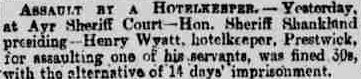

Newspaper article: Assault by a hotelkeeper. – Yesterday, at Ayr Sheriff Court – Hon. Sheriff Shankland presiding – Henry Wyatt, hotelkeeper, Prestwick, for assaulting one of his servants, was fined 30s, with the alternative of 14 days’ imprisonment.

I would hope that he was able to take the fine option...

On the 24 November 1899, Henry died at his home, South Lodge in Prestwick, of dropsy – a term used to describe the symptoms of what was often heart failure.10 His obituary referred to his “lengthened illness”.

Henry was buried in Glasgow, in the Southern Necropolis, and his funeral was conducted by his fellow Templars.11  It was this obituary, published in the Good Templar journal, that allowed me to learn about his service in the temperance movement, so I suggested these journals to the researcher who was looking for records. I neglected to tell her that the Templars' Scottish records are held at Glasgow University Archives - perhaps I should take my own advice and visit them to learn even more about Henry!


1 St Andrews by the Green Episcopal Church, Glasgow, Ref. TD243, Glasgow City Archive.

2 Edinburgh Gazette, 7 March 1871, https://www.thegazette.co.uk/Edinburgh/issue/8143/page/176.

3 Post-office annual Glasgow Directory, 1875-1876, https://digital.nls.uk/directories/browse/archive/84188037.

4 Helensburgh Heritage Trust, Temperance hotels were popular, https://helensburgh-heritage.co.uk/index.php.

5 Records of the International Order of Good Templars: Grand Lodge of Scotland, held at University of Glasgow Archive Services, https://archiveshub.jisc.ac.uk/search/archives/012fd6d2-c9e9-3cca-9807-aa919bf43c22

6 The Good Templar journal, c. 1900, Mitchell Library, Glasgow.

7 Post-office annual Glasgow Directory, 1897-1898, https://digital.nls.uk/directories/browse/archive/85331301.

8 Glasgow Herald, 27 November 1897.

9 Glasgow Herald, 12 August 1897.

10 “Dropsy,” University of Leeds Library Special Collections, https://library.leeds.ac.uk/special-collections/collection/2156.

11 The Good Templar journal, op. cit.


Tuesday, 26 April 2022

On the trail of my military McIntoshes


Siege of Burgos, 1812, Francois Joseph Heim (Public domain)

In search of my several-greats grandfather who fought at Waterloo – and who carried his wounded brother on his back on the retreat from the siege of Burgos in the Peninsular War, only to discover when they got to safety that his brother had died – I recently contacted the Black Watch Museum Archives in Perth (the Scottish one) to find out if they had any regimental records that might help identify said brother. I had previously been unaware of any siblings that great-grandpa Hugh had. 

Hugh was born in either Avoch (pronounced “Auch”) or Rosemarkie, depending on whether you believe the census or the military records. As they’re only a few miles apart it doesn’t really matter; both are in the area of Easter Ross known as the Black Isle, and neither of their parish churches’ records include a birth record for Hugh.  There are over 50 individuals with the surname McIntosh in the 1841 census taken in Avoch. Hugh isn’t one of them, however, as by that time he had retired from his military career and set up home in Nairn, on the other side of the Moray Firth, where seven of his nine children were born to him and his wife Elizabeth Sinclair.

He had more than likely been stationed at nearby Fort George during his service, as it was there, in the parish of Ardersier, that he and Elizabeth were married. Perhaps that was part of the reason for choosing Nairn as their home, after a life in the army.

I was delighted, then, to receive an email last week from the Black Watch archivist, Jennifer, who had made a search of the records they held and had not only found records that mentioned Hugh, but had managed to narrow down the identity of his brother, using a casualty list and other regimental records.  The only McIntosh who was in the same unit as Hugh and who died in the retreat from Burgos was named Donald. As he didn’t survive there won’t be any discharge or pension records at Kew, unfortunately.  But now that I know his name, it won’t be quite as much of a needle in a haystack task to find out more about him; perhaps in newspapers, or a local war memorial of some kind.

I don’t know whether the McIntoshes moved en masse from the Black Isle to Nairn, or if it was only Hugh who settled there.  It’s possible that Donald was born elsewhere in Scotland.  Hugh’s first two children were born in, respectively, France and Dublin, Elizabeth accompanying him both on campaign and in his postings.

Both Hugh and Donald are listed in this roll of Capt. James Stirling's Company

My next goal is to identify which of Hugh and Elizabeth’s five sons were also in the army.  His obituary mentions two, and gives their regiment and the places around the world in which they served.  So far I've found one described as a “pensioner” in his own newspaper death announcement. Sadly, he also appears to have had a lengthy and varied criminal record, with his name popping up regularly in the burgh police records and the court reports of the local Gazette. One can only imagine the possible PTSD that led him into such a life. It's his pension record that I'm going to try and find next.  Stay tuned for (hopefully) more finds!

Oh, and here's the newspaper obituary for Hugh which set me off on this chase. He was a bit of a character.

Nairnshire Telegraph, 4 February 1863 (courtesy of BNA)


Tuesday, 18 January 2022

Transcription Tuesday 2022


It’s become an annual tradition for Who Do You Think You Are? magazine to hold its crowdsourcing event, Transcription Tuesday, in February.  Everyone is invited to take part, and as usual, this year there are a few different projects involved.

For 2022, Tuesday 1st of February is the big day, but you should decide which project you’re going to work on in advance so you can familiarise yourself with the instructions. Additionally, you may need to register with the project to participate. To transcribe any record set, all you’ll need is your usual internet connection and PC or laptop.  You’ll have access to digital images of records, and these are the sources you will extract details from and type into the project software or document.  Choose the records you want to help with from

FamilySearch: the world's largest genealogical record organisation is seeking help to transcribe English parish registers.  If you don't already have a free FamilySearch account, you can easily create one, and this will allow you to pick a project under the "Indexing" tab on the website.  

HMS NHS: Seamen's Hospital registers.  Learn about these fascinating naval medical records, and check out the project's home page, which includes a chat function to put you in touch with other volunteers. 

National Library of Wales Photo Book Collection: tagging 19th century photographs of everyday life in Wales.  More on joining this project can be found at Who Do You Think You Are?'s website

Stories of St James's Burial Ground: the 18th century burial registers of the Parish of St James, Piccadilly.  This graveyard beside Euston Station was excavated by archaeologists in advance of an engineering project, and the burial records are held by the City of Westminster Archives.  They will need both transcription and highlighting. Find out more at the project's website


Thursday, 19 August 2021

The Scottish Jewish Heritage Centre: A Visit


Garnethill Synagogue, Glasgow

If you're in the Glasgow area, and have an interest in history (family, local, or international), in architecture or Judaism, this is THE place to visit.

Having recently undergone extensive refurbishment, the building, which houses the historic Garnethill Synagogue and the Scottish Jewish Archives Centre, now also includes a Holocaust-era studies centre, all part of the newly-launched Scottish Jewish Heritage Centre

This, the oldest purpose-built synagogue in Scotland, was designed by John McLeod of Dumbarton and opened in 1879, although the earliest recorded Jewish community in Glasgow dates from about 1821.  Tours of the synagogue itself have long been a regular feature of the annual Doors Open Day programme, but today I was honoured to join the first public tour of the revamped and modernised Heritage Centre.

The synagogue or shul was built for an Orthodox congregation which it still serves, so the layout of the prayer hall is quite traditional.  The Holy Ark at the east end is mightily impressive, as are the stained glass windows throughout the entire building.  Our guides explained the different features, traditions, and significance of each element of the space.  It is a beautiful place with a long and important heritage in both the Jewish and the wider community.


Holy Ark, Garnethill Synagogue

Interior, Garnethill Synagogue

You can read more about the synagogue’s history and architecture on its website

Moving downstairs to the newer parts of the Centre, our guides showed us a fascinating timeline display of Jewish history in Scotland, starting from the 18th century, illustrated with documents and photographs up until the present day.  We then got to look at the new Archives Centre, which tantalisingly also had a small bookshop that I had come totally unprepared for – fortunately it also has a website, which will likely be inflicting some damage on my credit card shortly.

Scottish Jewish Archives Centre

Scottish Jewish Archives Centre

This is an area where members of the public are welcome to use the specialist record collections and databases to trace the history of their Jewish families, many of whom will have been immigrants and, indeed, refugees from European nations during times of persecution and conflict.  Included is a complete set of the Glasgow-published Jewish Echo newspaper, a valuable source for family historians.  The Archives room also features a display highlighting prominent events and people in the city's Jewish community.


Postcard sent by Jewish refugee

Our final stop for the tour was the newly-created Holocaust-era studies centre. This houses a small library and study/meeting room for groups of young people learning important lessons from history about prejudice, displacement, and inclusion.  Using copies of immigration records, identity cards, letters, and so on, they can see life-changing events through the eyes of refugees.  Especially in the context of the current upheaval in Afghanistan, it's all the more relevant for students to focus on and understand the causes of the Holocaust and how to prevent it from happening again.

Holocaust Timeline Display, Succah

This part of the Centre has been created in the Succah, the area of the synagogue traditionally used to celebrate the harvest festival of Sukkot.  It has been transformed into a simple but powerful exhibition area, showing in detail the timeline of the Holocaust, its effects on various groups, and the experiences of those who escaped to safety in different parts of Scotland. Other displays highlight those who made this country their home, raised families, and made significant contributions to society.

Glasgow & Ayrshire Jewish Communities Display


I really appreciated the warm welcome extended by the tour guides, the breadth and depth of their knowledge of the building and its history, and their enthusiasm in explaining their tradition to visitors.  I can wholeheartedly recommend the tours which take place weekly and may be booked online.  School groups can also book time to visit the Centre as part of topic studies on religion or history.


Scottish Jewish Archives Centre


Monday, 26 July 2021

Now Open: Scotland

Tarbat Discovery Centre


Heritage venues around Scotland are beginning to reopen after extended closure periods, and travel restrictions having lifted mean that more of us will be getting out and about on research trips!

Here, I’m highlighting just a few places to visit, but do check with the relevant local authority or tourist office to find out what’s happening in your area of interest.  VisitScotland is a good source of information about current openings, as well as the limitations that still apply across the country regarding things like ferry travel or indoor activities.  

In the Highlands, Tarbat Discovery Centre has been able to start receiving visitors again and will do so until the end of October, Wednesday-Saturday each week.  This very atmospheric museum, housed in a former church, is well worth a wee detour from the North Coast 500, or the short drive from Inverness.  They’re also looking for local volunteers to help staff the museum.  

In Lanarkshire, Airdrie Local Studies Discovery Room, housed on the first floor of the public library, will be reopening this Thursday (28th July) for local and family history research on Thursdays and Fridays 11:00–12:30 and 14:00-15:30. Visit their website for more information and to book an appointment.

For those with Clyde shipbuilding in the family, Fairfield Heritage Museum in Govan is reopening too.  Starting from Tuesday August 3rd, they will once again be welcoming visitors and telling the story of the famous shipyard.  Visits are by free ticket until further notice, every Tuesday and Thursday afternoon, with social distancing measures in place.  You can book your ticket via Eventbrite.  

And I've just booked a tour of the Scottish Jewish Heritage Centre in Glasgow city centre, not far from the School of Art.  It's based in the beautiful Garnethill Synagogue, the first purpose-built synagogue in Scotland, and has the most exquisite stained glass.  As well as taking a guided tour of the Centre, you can benefit from the resources of its Archives, including the Scottish Holocaust-era collection.

For the time being, face coverings will be required indoors in public spaces in Scotland, so make sure you have a good supply of them to cover your trip!


Friday, 4 June 2021

A Grand (Virtual) Tour of Scotland’s Archives


Archives around the country are beginning to reopen, albeit with limited hours and document access, but in the meantime, come with me on a tour of some of their online offerings, courtesy of The Genealogy Show 2021.

In my presentation at the Show, I’ll be (virtually) roaming the archives of the Scottish islands, highlands, and lowlands from Kirkwall to Motherwell via Stornoway, Perth, and Edinburgh to name just a few, and checking out what genealogical goodies they share through their websites, blogs, and social media channels.

Archives are now taking greater advantage of these avenues to showcase the treasures they hold, allowing researchers to access certain resources from home.  I’ll also be sharing some tips for identifying the most suitable archives for your research purposes. 

The Genealogy Show launches online on Friday 25th June, with my Grand Tour airing at 6pm on Saturday 26th.  Tickets to the Show give you access to over 80 presentations, including on-demand keynote speakers, and you can also book a one-to-one consultation with an expert, or chat to genealogy exhibitors and family history societies.  Plus you’ll have access to all the talks for 30 days after the event.

Watch out for another post coming up soon about my presentation at the Show on Scottish research...


(Map credit: Created with Pictramap)

Friday, 22 January 2021

Free Scottish resources: Happy Burns Night!


Burns Monument Centre, Kilmarnock

To celebrate the birthday on January 25th of Scotland’s national bard, Robert Burns, I’ve put together a selection of free websites that may help you to grow your Scottish family tree a bit.

Ayrshireroots  Lots of links to explore including maps, reference books, and a surname database for the parishes and towns of Burns' native county.

Glasgow Valuation Rolls,1913-1914  Learn about and search these lists of Glasgow owners and occupiers, with the value of their properties, to locate your early 20th-century relatives living in the city.

SCAN – Scottish Archive Network  Identify useful genealogical sources using a keyword search of over 20,000 historical records in dozens of Scottish archives.

Statistical Accounts of Scotland 1791-1845  Background information for the entire country, parish by parish, in the 18th and 19th centuries.  These books were compiled from contemporary accounts written by locals about their own area, with descriptions of the parish, its history, its natural features and industries.  Excellent for learning about the times and places your ancestors lived in.

Scots Abroad  Whether your relatives went abroad to work, live, or visit, they may appear in these databases hosted by the National Library of Scotland.  These include correspondence from emigrants and guides for those planning to emigrate to different parts of the world.  Get a flavour of what life would have been like for people making their first trip away from Scotland.

Scottish Emigration Database  Search by the name of a person or the ship they sailed on. Thousands of entries from 1890 to 1960 list the address from which they were emigrating and their destination overseas.

And of course, a post about Burns Night wouldn’t be complete without a link to

Happy Haggis which has a great index to over 30,000 historical newspaper articles from 1848 to 1854, covering that crucial period just before civil registration began in Scotland.

Enjoy exploring these websites as you nibble on your Scottish treats or haggis-flavoured crisps and sip your choice of national drink.

Photo by Brett Jordan on Unsplash


Monday, 4 January 2021

Record Focus : Gibraltar List of Inhabitants

John Mace, North View of Gibraltar from Spanish Lines 
Government Art Collection, Public domain, via Wikimedia Commons

This week I’ve got a recommendation for an archive resource – the Gibraltar National Archives’ List of Inhabitants, which contains 219,229 records covering over six hundred years, from 1309 to 1920.  It’s got a very straightforward search function, so give it a play if you have relatives who might have spent any time there.

Clicking on the “Inhabitants” tab at the top of the page next to “Home” lets you switch to searching Military records – very useful as the Rock has had a significant British military presence for many years.  This particular record set contains births, marriages and deaths from 1869 to 1914.

It’s also well worth exploring the rest of this fascinating Archives website which includes historical background, photographs, and oral histories.

Tip: This may just be my browser, but I found the text on the Gibraltar site rather small, so I used this shortcut: to enlarge any text and images on any web page, simply press the "Ctrl" and "+" keys at the same time. You can do this as many times as you need to in order to make the text readable.  And to reverse the process if necessary, use "Ctrl" and "-" (minus) together.  (If you have an Apple device, the "Command" key works in a similar way to Windows' "Ctrl".)


Friday, 30 October 2020

Returning to the Archives: Glasgow City Archives @ The Mitchell

Archive search room, tables, chairs
Photo by Glasgow City Archives

Earlier this week, Glasgow City Archives re-opened, much to the delight of many researchers.  Things are a bit different, so I’ve highlighted some of the changes to access along with links to more information and booking details.  For those who can’t go in person, I offer a research service, or you can check out their online resources (link at the end of this post).

There is no current information on access to ScotlandsPeople via the Registrar service in the building.  Any announcements regarding this re-opening will be made on this Glasgow Council web page.

Glasgow City Archives

The Archives' new opening hours are Tuesday, Wednesday and Thursday only, between 11am and 3pm, and appointments are essential.  These must be booked at least one week and no more than four weeks in advance, and can be for no more than 3 hours at a time. The North Street entrance to the building is currently closed and only the Granville Street entrance is in operation, with queuing when necessary.

The archives staff will provide an advisory service in advance of your visit, with suggestions on what sources will best suit your research purposes.  You'll be able to pre-order up to six documents to view during your appointment.

For full details of the arrangements to visit the archives, see their Frequently Asked Questions

The booking form on this page should be filled in to apply for your appointment and submitted by e-mail.

Alternative online family history resources are listed on this page, under the Special Collections and Glasgow City Archives section. There are a variety of databases you can search online, including church and militia records.

The Virtual Mitchell website has an extensive collection of historical photographs of Glasgow buildings, which you can search by area, street, or subject. 

Special Collections at the Mitchell Library

The Special Collections department of the Mitchell, on the same floor as the Archives, is also open, under restricted conditions.  Of particular interest to family historians are their newspaper collections, microfilm records, monumental inscriptions, and local history books. 

In future blog posts I'll be following the re-opening of other archives, and sharing information about those record offices that are starting to welcome visitors once more.

Tuesday, 13 October 2020

Searching for London Ancestors


Temple Church, London

Libraries and archives are starting to reopen under special conditions, such as pre-booking a seat or specific records.  It’s always a good idea to check opening hours and other arrangements, and that’s especially true at a time when repositories are restricting the numbers of visitors per day, as well as the number of documents you can order or view in one visit.  Some of the first sites to welcome researchers in person again are in London.

The National Archives at Kew have been open for a few weeks now, but they continue to offer free downloads of records that are already available in digital format.  As this will probably return to being a paid service, find out what they have that's of use to your research, and get your free documents while you can!

If your focus is on the City of London, the Guildhall Library has excellent resources for that area, such as parish records for many of the oldest churches, including some that were destroyed in the Second World War.  For those planning a trip to the Library once it's open again, its virtual open day should be of interest.

The Library recently had a reprieve from controversial proposals that would have seen it merged with London Metropolitan Archiveswhich hosts a myriad of original sources, including workhouse, electoral, and school records.  They have a comprehensive guide to London family history research and a video introduction to using the archives.

For those of us who can't visit in person, certain relevant collections are available online.  One of the lesser-known ones is the Consistory Court Database, which covers the late medieval period in London.  Although an ecclesiastical body, the consistory court governed all aspects of life, including debt, marriage, defamation, and probate matters.

If you’re investigating the life of someone who lived and worked in London, they may appear in the records of London’s Livery Companies, who provide lists of apprentices and freemen. Trades such as chandlers, musicians, salters and goldsmiths feature in these fascinating rolls.

To learn more about ordinary Londoners through social history, check out London Lives.  Its resources include a database of convicted criminals who were transported to Australia.  Some fascinating cases are highlighted and will give you an idea of what kind of information can be gleaned from these records, which also cover the Old Bailey - this has its own separate searchable database of criminal trials from 1674 to 1913.

Finally, you may think of joining a family history society that covers the part of London your forebears come from.  GENUKI has a useful guide to the various groups that take in London and the surrounding areas.  Many societies are taking to video conferencing as a way to include their members near and far in meetings and workshops.  And they are continuing with traditional FHS routes like magazines, newsletters, and registers of members' surname interests.

Tuesday, 28 July 2020

Free Family History Mini-Class : Lesson 3


Once you’ve identified the repository that holds the records you need to search, you can start to make preparations for your visit there.

Here are my suggestions for ensuring nothing gets forgotten:

      Contact the archive in advance to make an appointment, where necessary, as well to pre-order any materials that require notice to consult.  Make the most of archive staff's expertise in the records and the local area by asking them for advice regarding your search.

      Make a list of all the records you want to see, alongside the names of the people you hope to find in them.  For instance: Sequestration records - Andrew Byrne, 1911 - and include the reference numbers from the catalogue, to save time looking them up again.

      Put together a file or database to take with you that contains details of all the relevant family groups that you will be researching.

      Review the rules and visitor information on the repository’s website or in their literature to ensure you are properly prepared, for instance
  • Whether you can buy food there or need to take your own, and if there is somewhere on the premises you can eat
  • If change is required for lockers or cloakroom - you won't be permitted to take your coat, bags, or food and drink items into the search area. Many archives provide clear plastic carrier bags to allow you to carry essential research kit to your seat
  • ID requirements. You may not get into the archive without specific forms of identification, so be sure to take the correct paperwork with you on the day

      Practice some palaeography if you’re going to be consulting records with unfamiliar handwriting styles.  I’ve listed some websites to help with that.

      Prepare a research log book or use pre-printed log sheets to keep track of what you find, what you don’t find and, most importantly, which records you’ve searched. This is a good safeguard against re-doing the same work. 
Download and use this ready-made log sheet.


In the next class I'll explore some of the 
options for organising your family information.

Monday, 20 July 2020

Free Family History Mini-Class : Lesson 2


In this lesson, find out how to identify which record office, archive or library you need to visit in order to move your research forward.  If you missed Lesson 1, you can catch up here.

      Do your homework by reading background material on the place and time your ancestors lived in, and find out what types of records they may have generated: consider court documents, rental rolls for tenants, electoral registers, and school records, for instance.

      Use the websites of archives in your ancestors’ city, county or country to learn what kinds of records they hold, and what information those contain.  Specific subject guides are often available to download and study.

      Search online catalogues.  Some apply just to individual archives and are found on their websites, while others such as The National Archives’ cover the country as a whole – check out their guide for mining the catalogues

      Be aware that as well as official government records, archives are held by charitable, religious, business, private, and academic organisations.  If you know that your ancestor worked in a specific profession, for example shipbuilding or medicine, you should consider investigating what relevant archives exist.

      Contact the archive(s) you plan to visit if you’re not sure what records will help you.  Staff have an excellent working knowledge of their resources and can advise you on how to get the most out of them.

      Make sure that the documents you want to see will be available at the time of your visit.  Some are stored off-site and require advance notice to be produced for searching – you should see indicators of this in catalogue entries.  Records undergoing conservation might also be out of circulation, but staff will be able to check this for you.

The next mini-class will focus on practical
 preparations to make for your research trip.

If you've a question about this lesson, just
post it in the comments below.