Tuesday, 25 January 2022

Free Online Genealogy Presentations


Legacy Family Tree Webinars 1-Day Conference – Saturday 29th January 

Legacy is a subscription website which, from this Saturday, begins a monthly series of free one-day conferences, using their existing presentations which are usually only available to subscribers. They will also include some new classes. Of course this is a marketing strategy, to draw in paying customers, but these conferences really are free.

This month, the theme of the conference is Organization, and the free classes are

  • Organization: Create a Finding Aid to Locate Your Records, by Teri E. Flack
  • Get Organized Using the FamilyRoots Organizer Colour-Coding System, by Mary Hill
  • Maintaining an Organized Computer, by Cyndi Ingle
  • Organize Your Online Life, by Lisa Louise Cooke
  • You Can Do This: Photo Organizing and Preservation, by Thomas MacEntee
There is no timetable or registration; the presentations will simply be made available on the set date.  Visit the conference website and choose which talks you want to watch, in whichever order you like.  As part of each class, there will also be a free speaker handout (syllabus) to download.


Family History Library Classes and Webinars - Mondays-Thursdays

FamilySearch hold regular online classes throughout the year.  For February and March these will cover using the website's different tools to find, document, and add photos to your family record.  Research Webinars are also scheduled to help build your skills in areas like researching different countries' records, using DNA, and understanding Latin handwriting.

Registration is necessary as class numbers are limited, so when you see a topic you are interested in, sign up for it right away.  And the beginning of March will see FamilySearch's second free global event, RootsTech 2022 - watch out for a future post here about that!


Scottish Indexes Conference XVI – Saturday 12th March

Husband-and-wife team Graham and Emma Maxwell operate their genealogy research business from their home in the west of Scotland, and since the advent of the global pandemic which severely restricted access to essential archives, they have diversified significantly. Just under two years ago, they started organising online conference programmes and made them available at no cost to anybody who wanted to join in via either their Facebook group or Zoom.  Each talk is shown twice on the day, to allow viewers from around the world to take part in their timezone.  You can browse previous presentations and handouts at their Past Conferences page


Have you been deliberately avoiding Zoom presentations? 

1.    Not all of these events require you to use Zoom

2.    It's completely free to use the basic package.

2.    Zoom isn't the problem it's been cracked up to be! Watch the first two-and-a-half minutes of this introductory video to see how straightforward it is to join a Zoom meeting.


Tuesday, 18 January 2022

Transcription Tuesday 2022


It’s become an annual tradition for Who Do You Think You Are? magazine to hold its crowdsourcing event, Transcription Tuesday, in February.  Everyone is invited to take part, and as usual, this year there are a few different projects involved.

For 2022, Tuesday 1st of February is the big day, but you should decide which project you’re going to work on in advance so you can familiarise yourself with the instructions. Additionally, you may need to register with the project to participate. To transcribe any record set, all you’ll need is your usual internet connection and PC or laptop.  You’ll have access to digital images of records, and these are the sources you will extract details from and type into the project software or document.  Choose the records you want to help with from

FamilySearch: the world's largest genealogical record organisation is seeking help to transcribe English parish registers.  If you don't already have a free FamilySearch account, you can easily create one, and this will allow you to pick a project under the "Indexing" tab on the website.  

HMS NHS: Seamen's Hospital registers.  Learn about these fascinating naval medical records, and check out the project's home page, which includes a chat function to put you in touch with other volunteers. 

National Library of Wales Photo Book Collection: tagging 19th century photographs of everyday life in Wales.  More on joining this project can be found at Who Do You Think You Are?'s website

Stories of St James's Burial Ground: the 18th century burial registers of the Parish of St James, Piccadilly.  This graveyard beside Euston Station was excavated by archaeologists in advance of an engineering project, and the burial records are held by the City of Westminster Archives.  They will need both transcription and highlighting. Find out more at the project's website


Monday, 10 January 2022

Help for Using the 1921 Census

Census Records by Nick Youngson CC BY-SA 3.0 Alpha Stock Images

It’s been a big week for genealogists with English or Welsh ancestors! The 1921 Census was released on FindMyPast and has been greeted mainly with rejoicing.  There have been some folk who want to be able to access it free of charge, but then they’d have to go to a library and scroll through miles of microfilm, since the charges pay for the digitising and indexing that has been done.  And of course, it IS free to access at three archives/libraries in England and Wales

There's plenty of online material explaining how to make the best use of the collection to track down grandparents and great-great-aunts (and in some cases, parents - you know who you are). Some of these free resources are listed below.

☙  Family Tree magazine posts an Introductory User Guide (although there is a charge to watch their “Celebratory Census Conference”)

☙  The National Archives hosted an expert panel discussion which you can watch back on their Facebook page

☙  FindMyPast’s YouTube channel has several videos about the background to the census and its digitsation project plus a short how-to clip. 

☙  They also have two Facebook live events coming up this week, on Wednesday and Thursday (both at 4pm UK time), where you can ask questions about the census and hear about some of the interesting finds made by the conservation team

Some of the most useful suggestions for searching the 1921 returns have come in the shape of social media posts by family historians sharing their tips.  Tune in to Twitter for #AncestryHour, either in real time any Tuesday at 7pm (UK), or by catching up using the hashtag later on, and you’re sure to see the census discussed and perhaps catch some ideas for research strategies.


Scottish Indexes Conference

In other online event news, this Saturday (15th) sees the latest Scottish Indexes Conference. It will run two showings of each presentation, morning and afternoon, for participants in different time zones.  The talks will cover topics of particular interest to researchers with Scots heritage, such as crofting, Edinburgh and Lanarkshire records.  Find out more about the speakers, and how to watch, via Zoom or Facebook on the Scottish Indexes website


Tuesday, 26 October 2021

Never Stop Looking


Argus, Melbourne, 19 Jul 1950

Last week I posted a bit about my grandfather and the kind of fellow he turned out to be.  This week, after a 45-year wait I bring you news of his brother Duncan.  Previously all that had been known about him after departing Glasgow was that he had emigrated to Australia.  No further word about him reached my mother’s family.

Yesterday, an e-mail alert from MyHeritage which had been languishing unread in my inbox for several weeks revealed some suggestions for records about various men named Duncan Paul. Most of them seemed to be from American city directories, and I was about to delete the e-mail when the birth date of my great-uncle jumped off the screen.  Sure enough, he had ended up in Australia, and one of his relatives there had posted his information on the website.  From it I gleaned a fair bit of interesting detail, which makes up much of the following story.

Duncan, my mum’s uncle, was born in 1914 in Glasgow, and married Elizabeth there just after the outbreak of World War 2.  He was involved in military service and seems to have been posted to the south coast of England because it was in Southampton, about 1946, that he met a lady called Ivy.

Ivy was a recently-widowed mother of five.  Her husband Charles had been a steward in the merchant navy but died in September 1945 and is commemorated in a war grave.  Ivy and Duncan had a child together, and then in 1949 she left with the children for Australia.

Cameronia
(Marxchivist from USA on Flickr, CC BY 2.0, via Wikimedia Commons)

Duncan also applied to emigrate, and in 1950 had been accepted when, during a spell working on Southampton dock, he got itchy feet.  The ship Cameronia berthed and he learned that it was bound for Australia, so on the night before it sailed he packed three suitcases and brazenly marched aboard, his confidence fooling crew and passengers alike.  However, after five days without food he surrendered himself to the captain, who appears to have taken pity on the stowaway and allowed him to work the remainder of his passage.

When the ship docked at Colombo in present-day Sri Lanka, Duncan sent a telegram to Ivy to let her know he was on his way.  She was his sponsor for the purposes of emigration and when the Cameronia arrived in Melbourne she was there on the quay to greet him.  Australian newspapers carried the story of the “Scottish stowaway” and printed the photograph at the beginning of this post, along with a physical description of Duncan as being freckle-faced, red haired and slightly built.

But what of his wife Elizabeth back in Glasgow? This is where the Australian newspaper account is silent, but records show that it was not until 1952 that she obtained a divorce from Duncan.  His address on the legal documents was "unknown", so as yet it's not clear if Duncan ever knew he was divorced, nor if he married Ivy.  

But really, never give up on a search for a relative, no matter how long you've been looking!

Tuesday, 19 October 2021

Putting the Pieces of the Puzzle Together


Mitchell Library, Glasgow
(PC: Stinglehammer, CC BY-SA 4.0 via Wikimedia Commons)

Some of the most useful record sets in Scotland are poor law application forms. Glasgow’s collections of these are the most extensive (over a million records) and are name-indexed on a computer database held in Glasgow City Archives at the Mitchell Library.

I’ve been using these fantastic records for many years now, and I tend to forget that more are being added each year, as they're released from the closure period (75 years for adults, 100 for children).  So I was surprised to find a record of my grandparents applying for help from the parish in 1924 – not that their circumstances were unexpected, just that I hadn’t realised enough time had elapsed for their records to be available!

This was the same grandfather who I last year came across in the British Newspaper Archives’ collection – completely by accident, as his combination of names runs through several generations of the family – and was stunned to learn that he had been caught red-handed with the proceeds of a burglary, taken to court, and ended up in prison.  The newspaper accounts gave enough detail for me to know that he was working away from home at the “berry picking” on a farm in Perthshire, and had been trying to pawn one of the “hot” stolen items in Stirling.  Police followed his trail to the farm and arrested him, and he was tried at Perth Sheriff Court and sentenced to fourteen days in jail.

Strangely enough (!), he does not mention any of this in the poor law application on my grandmother’s behalf, made just a few months later.  He surely knew that if he confessed to any of the above, the inspector assessing his case would be much less likely to look favourably upon his application for parish support.  Already noted as being against him were the fact that he hadn’t served in the army, and was currently “idle” i.e. out of work and claiming unemployment benefit.

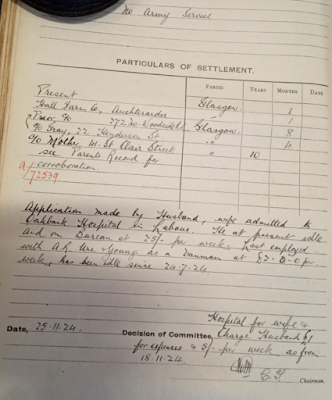
The reason for the application was that my grandmother was in labour with her second child and they couldn’t afford the medical fees, this being in the days before the National Health Service.  Granddad made his request for assistance at 5.40am on the morning of November 18th, 1924, and the documents confirm that the baby was born later that day in Oakbank Hospital in the north of the city.  A note at the foot of the page below shows that he was expected to pay £1 for the medical treatment, in weekly instalments of five shillings.

Photo courtesy of Glasgow City Archives

This “Particulars of Settlement” document was a standard part of the poor law paperwork, and it listed the couple’s past addresses - this was to prove they were entitled to receive support from the parish granddad was applying to.  It also conveniently gives the reference number of his own parents’ previous application documents.

Interestingly, among the list of previous addresses – and as this was an application on behalf of my grandmother, she at least would have been living there – was a farm in Auchterarder, in Perthshire.  It isn’t named in the newspaper reports, but I suspect this was the place where the law caught up with granddad – and what on earth was he playing at, dragging my heavily-pregnant grandmother around the country, earning money by picking fruit?!  The schoolhouse he burgled was in the same area, too.  I had a mental image of granny working in the fields while he wore a mask and striped jersey to break in and steal a lady’s gold watch, a rare Indian scarf pin, binoculars, and clothing (according to the Sunday Post).

It’s extremely satisfying when two totally unrelated sources corroborate each other like this.  It also paints a sad picture of life on the poverty line in 1920s Glasgow, although not to excuse granddad’s behaviour, it was a definite red flag. He eventually abandoned his wife and three children (now including my own mother) and left them to look after themselves – which my granny did, and a good job she made of it too.  He played no further part in my family’s life.

There’s another story attached to that aspect of this, but that’s for some other time!

Tuesday, 12 October 2021

Who Do You Think You Are? Returns


Tonight (9pm UK time) the latest series of the genealogy programme Who Do You Think You Are? begins.  A new tranche of celebrities will share their family trees, and hopefully demonstrate some techniques and record sources that will be of interest to family historians.  Having seen the USA’s version of this show, I think it’s fair to say that viewers from either side of the pond don't always recognise celebs from across the water, who may be less well-known to a transatlantic audience.  I confess to not knowing who some of the US series' subjects were, although they were clearly popular over there!

While I’m pretty sure that most international fans of the programme would recognise Dame Judi Dench in the new UK series, those not familiar with British politics (or Strictly) might struggle to identify Ed Balls.  However, and this is especially useful for those who don’t have access to BBC TV services on its iPlayer platform, there is a large back catalogue of the previous WDYTYA? series available on YouTube.  Here, there are some slightly more high-profile subjects: J.K. Rowling, John Hurt, Kate Winslet, Daniel Radcliffe, Courteney Cox, and Boris Johnson, to name just a few. 

Some of their ancestors' stories are tragic, others inspiring – for instance, J.K. Rowling discovers a French military hero in her family.  For me, one of the most memorable instalments was about actor Alan Cumming’s father. I won’t spoil it for you but it does have a very different outcome.

Another unrelated, but no less fascinating family history BBC show that aired recently was a standalone documentary about a young woman seeking to discover her birth parents’ identities.  Having been abandoned as a baby and with the support of her adoptive family, she used DNA to try and trace blood relatives.  Shown as part of the Our Lives collection of programmes, it’s called Finding My Family and can be viewed on iPlayer.

Hopefully some of the family stories told in these productions will encourage you to keep researching when you feel like giving up, or to develop a better appreciation for those who have gone before us.

Tuesday, 5 October 2021

Genealogy Extras: Free Course & Free Conference!


More great learning opportunities are being offered all over the genealogy community - here are just two to keep you occupied!

The free online 6-week course run by the University of Strathclyde, “Genealogy: Researching Your Family Tree” is starting on 18th October.  Register soon as places go fast on this course, even though it runs more than once a year. 

Centred around a real-life case study, the course allows you to work through the materials at your own pace, and discuss related questions and issues with other participants from across the world.  As well as explaining key record types, you will discover how DNA fits in to modern family history research, and learn about different ways to record, organise and share your genealogy.

Also worth checking out is the recent conference of the Register of Qualified Genealogists.  Many of the presentations from this excellent event were recorded and can be viewed until 31st October.  Just a few of the talks on the programme are

  • Jilted! Or the insights offered in a breach of contract of marriage cases
  • Hidden History: Tales of everyday life in Newspaper Advertisements
  • Life of the Early Victorian Deaf & Dumb
  • Dusting & Digging: The Work of Women
  • Lying Bastards: the impact of illegitimacy on family history research
I thoroughly enjoyed all these presentations, which were highly entertaining as well as informative, and came away with plenty of ideas to further my research.